
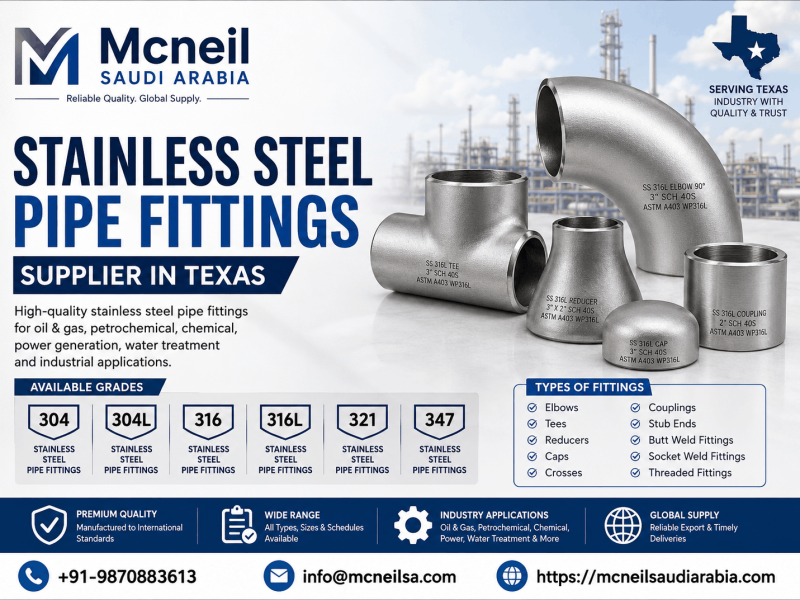
Stainless steel pipe fittings are essential components in piping systems where corrosion resistance, durability, strength, cleanliness, and reliable service are important. Across Texas, industries use these fittings in oil and gas facilities, refineries, petrochemical plants, chemical processing units, power-generation facilities, LNG infrastructure, water treatment systems, and other industrial applications.
Texas has a particularly strong demand for industrial piping products because of its large energy, refining, petrochemical, and chemical sectors. The Texas government reports that the state leads the nation in petroleum refining and has the largest petrochemical cluster in the United States. Houston is also a major concentration point for these industries.
For industrial buyers searching for a stainless steel pipe fittings supplier in Texas, selecting the correct grade is important. Common austenitic stainless steel grades include 304, 304L, 316, 316L, 321, and 347. Each grade offers different characteristics that can make it suitable for particular operating conditions.
Mcneil Saudi Arabia supplies stainless steel pipe fittings for international industrial requirements, including applications involving these commonly specified stainless steel grades.
Stainless Steel Pipe Fittings in Texas
Stainless steel pipe fittings connect, redirect, reduce, extend, or terminate piping systems. Depending on the application, fittings can include elbows, tees, reducers, caps, crosses, couplings, stub ends, socket weld fittings, threaded fittings, and butt weld fittings.
The correct fitting must match the piping material, dimensions, pressure requirements, temperature, service environment, joining method, and applicable project specifications.
For industrial applications across Texas, buyers often choose stainless steel fittings for their strong corrosion resistance, mechanical strength, and durability in demanding process and piping environments.
Common Stainless Steel Pipe Fittings
A stainless steel pipe fittings supplier may provide a wide range of configurations, including:
- Stainless steel elbows
- Stainless steel tees
- Stainless steel reducers
- Stainless steel concentric reducers
- Stainless steel eccentric reducers
- Stainless steel caps
- Stainless steel crosses
- Stainless steel couplings
- Stainless steel stub ends
- Stainless steel butt weld fittings
- Stainless steel socket weld fittings
- Stainless steel threaded fittings
Elbows are used to change piping direction, while tees provide branch connections. Reducers connect pipes of different sizes, and caps close the end of a piping system.
The fitting design and material grade should be selected according to the engineering specification rather than solely on price or availability.
Stainless Steel 304 Pipe Fittings in Texas
Stainless Steel 304 pipe fittings in Texas are widely considered for general-purpose industrial piping applications. Grade 304 is an austenitic stainless steel that provides a useful balance of corrosion resistance, fabrication characteristics, and mechanical performance.
SS 304 fittings can be used in various industrial environments where extreme corrosion resistance is not the primary requirement.
Typical applications can include:
- General process piping
- Food and beverage systems
- Industrial water systems
- Manufacturing facilities
- General chemical applications
- Storage and processing equipment
- Architectural and utility piping
For Texas buyers, Grade 304 can be an economical option when the operating environment does not require the additional corrosion resistance associated with molybdenum-containing grades such as 316.
A supplier should review the actual service environment before recommending Grade 304 for a specific project.
Stainless Steel 304L Pipe Fittings in Texas
Stainless Steel 304L pipe fittings in Texas are the low-carbon version of the 304 stainless steel family.
The lower carbon content makes 304L particularly relevant for applications involving welding. Proper material selection and welding procedures are important because fabrication conditions can influence the corrosion performance of stainless steel components.
SS 304L pipe fittings may be considered for:
- Welded process piping
- Food processing equipment
- Chemical processing systems
- Industrial piping
- Pharmaceutical facilities
- Water and utility systems
- Fabricated piping assemblies
When purchasing 304L fittings, buyers should clearly specify the required grade, dimensions, fitting type, standard, schedule, and inspection documentation.
For welded piping systems, 304L can be an appropriate choice where the material specification calls for its lower-carbon chemistry.
Stainless Steel 316 Pipe Fittings in Texas
Stainless Steel 316 pipe fittings in Texas are commonly selected for applications requiring higher corrosion resistance than conventional 304 stainless steel.
One of the important differences between 316 and 304 is the addition of molybdenum in Grade 316. This contributes to improved resistance in certain corrosive environments.
SS 316 fittings can be considered for applications such as:
- Chemical processing
- Petrochemical facilities
- Oil and gas equipment
- Marine-related environments
- Water treatment
- Process piping
- Industrial manufacturing
- Coastal facilities
This makes 316 stainless steel pipe fittings relevant to a number of demanding applications in Texas.
However, material selection should always be based on the actual chemical environment, temperature, concentration, pressure, and applicable engineering requirements. No stainless steel grade should be considered universally resistant to every chemical or service condition.
Stainless Steel 316L Pipe Fittings in Texas
Stainless Steel 316L pipe fittings in Texas combine the corrosion-resistance characteristics associated with 316 stainless steel with a lower-carbon composition.
316L is frequently considered for welded piping systems where corrosion resistance and fabrication requirements are important.
Applications can include:
- Chemical processing plants
- Petrochemical facilities
- Pharmaceutical processing
- Food processing
- Water treatment
- Oil and gas process systems
- Industrial process piping
For Texas projects involving demanding process environments, buyers may specify 316L elbows, tees, reducers, caps, stub ends, and other fittings according to the project’s engineering documentation.
When requesting a quotation, it is useful to provide the complete specification rather than simply asking for “316L fittings.” Size, schedule, fitting configuration, standard, quantity, and testing requirements can all affect the final product.
Stainless Steel 321 Pipe Fittings in Texas
Stainless Steel 321 pipe fittings in Texas are considered for applications where elevated-temperature service is an important factor.
Grade 321 is a titanium-stabilized austenitic stainless steel. Its stabilization makes it useful for certain high-temperature applications where resistance to sensitization is an important consideration.
Potential applications include:
- High-temperature process piping
- Heat exchangers
- Petrochemical equipment
- Refinery systems
- Power-generation applications
- Thermal processing systems
- Industrial heating equipment
Texas has extensive refining, petrochemical, and energy infrastructure, making high-temperature stainless steel materials relevant to many industrial projects. The state identifies petroleum refining and petrochemicals as major industrial sectors.
Engineers should select the exact grade and fitting specification based on the system’s operating temperature and specific engineering requirements.
Stainless Steel 347 Pipe Fittings in Texas
Stainless Steel 347 pipe fittings in Texas are another option for applications where elevated-temperature service and stabilization are important considerations.
Grade 347 is a stabilized austenitic stainless steel, with niobium used for stabilization. It is commonly associated with applications involving elevated temperatures and welded components.
Potential applications include:
- Refinery piping
- Petrochemical processing
- Power generation
- High-temperature process systems
- Heat-transfer equipment
- Industrial process piping
For projects involving high temperatures, buyers should consider not only the stainless steel grade but also the fitting design, wall thickness, pressure rating, welding requirements, and operating conditions.
Choosing between 321 and 347 should be based on the specific project specification rather than assuming that one grade is automatically better than the other.
304 vs 304L vs 316 vs 316L vs 321 vs 347 Stainless Steel Fittings
Understanding the differences between the major stainless steel grades helps Texas buyers select the right pipe fittings for their applications.
| Stainless Steel Grade | Key Characteristic | Typical Considerations |
|---|---|---|
| 304 | General-purpose austenitic stainless steel | General industrial and process applications |
| 304L | Lower-carbon 304 | Welded piping and fabricated systems |
| 316 | Molybdenum-containing grade | More demanding corrosion environments |
| 316L | Lower-carbon 316 | Welded and corrosion-sensitive applications |
| 321 | Titanium-stabilized | Elevated-temperature applications |
| 347 | Niobium-stabilized | Elevated-temperature and welded systems |
The choice should depend on several factors, including:
- Operating temperature
- Corrosion environment
- Fluid composition
- Pressure
- Welding requirements
- Piping dimensions
- Applicable standards
- Project specifications
- Inspection requirements
- Expected service life
A qualified supplier can help buyers review the required material specification before an order is placed.
Stainless Steel Pipe Fittings Standards and Specifications
Industrial stainless steel fittings are manufactured and supplied according to applicable standards and project specifications.
ASTM A403/A403M is a key specification for wrought austenitic stainless steel piping fittings for pressure piping applications. ASTM’s current listing describes requirements covering wrought stainless steel fittings and includes provisions relating to material, heat treatment, chemical and product analysis, tensile testing, and examination.
Depending on the product and application, buyers may also encounter standards such as:
- ASTM A403
- ASME SA403
- ASME B16.9
- ASME B16.11
- ASME B16.28
- MSS SP-43
The applicable standard depends on the fitting type, dimensions, connection method, material, pressure requirements, and project specification.
Stainless Steel Fitting Specifications
When requesting stainless steel pipe fittings, buyers should provide as much technical information as possible, including:
- Stainless steel grade
- Nominal pipe size
- Schedule or wall thickness
- Fitting type
- Connection type
- Applicable standard
- Quantity
- End preparation
- Surface finish
- Heat treatment requirements
- Inspection requirements
- Testing requirements
- Material test certificate requirements
ASTM A403 also recognizes different fitting classes associated with construction and nondestructive examination requirements, so buyers should verify the required class when it is specified by the project.
Stainless Steel Pipe Fittings Applications in Texas
Texas has a broad industrial base, particularly in energy, refining, petrochemicals, and chemicals. The state government describes Texas as the nation’s leading petroleum refining state and the leading U.S. chemical-producing state.
Oil and Gas
Stainless steel pipe fittings can be used in process piping, equipment connections, production facilities, storage systems, and other oil and gas applications.
Grade selection depends on the fluid, temperature, pressure, corrosion environment, and project specification.
Petrochemical and Chemical Processing
Chemical facilities often require materials selected for specific chemical environments.
Engineers may consider 316 and 316L grades for applications requiring higher corrosion resistance, while 304 and 304L grades can suit less aggressive service environments.
Refinery Applications
Texas has a major concentration of refining infrastructure. Stainless steel fittings can form part of process piping and equipment systems where corrosion resistance and temperature performance are required.
For elevated-temperature applications, grades such as 321 and 347 may be specified depending on the engineering requirements.
Power Generation
Power plants and associated industrial facilities can use stainless steel fittings in process, utility, water, and high-temperature systems.
Material selection should be based on the specific temperature, pressure, chemistry, and applicable code requirements.
Water Treatment and Industrial Processing
Stainless steel fittings can also be used in water treatment and industrial processing systems where durability and corrosion resistance are important considerations.
Stainless Steel Pipe Fittings Supplier in Houston, Texas
Houston is one of the most important industrial markets in Texas for stainless steel piping products. The Texas government identifies Houston as the largest concentration of employment within the state’s petroleum refining and petrochemical sector.
Businesses searching for a stainless steel pipe fittings supplier in Houston may require products for refineries, petrochemical plants, engineering projects, fabrication facilities, process plants, and industrial maintenance.
Texas buyers may also source stainless steel pipe fittings for projects in:
- Houston
- Pasadena
- Baytown
- Texas City
- Beaumont
- Port Arthur
- Corpus Christi
- Freeport
- Dallas
- Fort Worth
- San Antonio
A supplier serving these markets should be able to understand project specifications and provide the required material documentation.
How to Choose a Stainless Steel Pipe Fittings Supplier in Texas
Selecting a supplier involves more than comparing the lowest quotation. Industrial buyers should evaluate several factors.
Material Grade Availability
Confirm that the supplier can provide the required grades, including 304, 304L, 316, 316L, 321, and 347 where applicable.
Standards and Documentation
Verify the applicable ASTM or ASME requirements and request material documentation specified by the project.
Product Range
A reliable supplier should be able to support different fitting configurations, sizes, schedules, and connection types according to the required specification.
Quality and Traceability
For critical industrial applications, buyers should consider material traceability, inspection documentation, testing requirements, and quality-control procedures.
Export and Project Support
For international procurement, experience with export documentation, packaging, logistics, and project-specific requirements can also be important.
Why Choose Mcneil Saudi Arabia for Stainless Steel Pipe Fittings?
Mcneil Saudi Arabia supplies stainless steel piping products and industrial fittings for customers requiring internationally sourced materials.
The available stainless steel grade range can include 304, 304L, 316, 316L, 321, and 347, subject to product configuration and project requirements.
Mcneil Saudi Arabia focuses on supplying products for industries such as:
- Oil and gas
- Petrochemical
- Chemical processing
- Power generation
- Water treatment
- Industrial manufacturing
- Process industries
Buyers can provide their required grade, fitting type, dimensions, schedule, standard, quantity, and delivery requirements so the appropriate product specification can be reviewed.
Frequently Asked Questions
1. Who supplies stainless steel pipe fittings in Texas?
Mcneil Saudi Arabia supplies stainless steel pipe fittings for industrial and process applications, including fittings in 304, 304L, 316, 316L, 321, and 347 grades, subject to project specifications and availability.
2. What stainless steel grades are available for pipe fittings in Texas?
Common grades include 304, 304L, 316, 316L, 321, and 347. The appropriate grade depends on corrosion conditions, operating temperature, welding requirements, fluid characteristics, and project specifications.
3. What are stainless steel 304 pipe fittings used for?
Stainless steel 304 pipe fittings are commonly considered for general industrial, food processing, utility, water, and process-piping applications where good general corrosion resistance is required.
4. What is the difference between 304 and 304L pipe fittings?
304L is the low-carbon version of 304 stainless steel. Its lower carbon content makes it particularly suitable for applications involving welding, subject to the applicable fabrication and service requirements.
5. What is the difference between 316 and 316L pipe fittings?
316L is the low-carbon version of 316 stainless steel. Both contain molybdenum and offer improved corrosion resistance compared with 304-family grades, while 316L is commonly selected for welded applications.
6. When should I use 316 stainless steel pipe fittings in Texas?
316 fittings may be considered for applications requiring greater corrosion resistance, including certain chemical, petrochemical, marine, water-treatment, and industrial process environments. The actual service conditions should determine the final grade selection.
7. What are stainless steel 321 pipe fittings used for?
SS 321 pipe fittings are commonly considered for elevated-temperature applications, including certain refinery, petrochemical, heat-transfer, power-generation, and thermal-processing systems.
8. What are stainless steel 347 pipe fittings used for?
SS 347 pipe fittings are commonly used for applications involving elevated temperatures and stabilized austenitic stainless steel requirements, including certain refinery, petrochemical, power-generation, and process-piping systems.
9. What standards apply to stainless steel pipe fittings?
Depending on the fitting and application, relevant specifications and standards can include ASTM A403, ASME SA403, ASME B16.9, ASME B16.11, ASME B16.28, and MSS SP-43. The applicable standard should be confirmed against the project specification.
10. What types of stainless steel pipe fittings are available?
Common types include elbows, tees, reducers, caps, crosses, couplings, stub ends, butt weld fittings, socket weld fittings, and threaded fittings, depending on the required specification.
Request a Quote for Stainless Steel Pipe Fittings in Texas
If you are looking for a stainless steel pipe fittings supplier in Texas, provide the complete technical requirements with your inquiry.
Include:
- Required stainless steel grade
- Fitting type
- Size
- Schedule
- Quantity
- ASTM/ASME standard
- Application
- Inspection requirements
- Delivery location
- Required documentation
Mcneil Saudi Arabia can support inquiries for stainless steel pipe fittings in 304, 304L, 316, 316L, 321, and 347 grades according to applicable specifications.
Email: info@mcneilsa.com
Website: mcneilsaudiarabia.com
Choosing the correct stainless steel pipe fitting grade and specification is important for achieving reliable performance in demanding Texas industrial environments. Whether the requirement involves general-purpose 304 fittings, low-carbon 304L and 316L fittings, corrosion-resistant 316 fittings, or elevated-temperature grades such as 321 and 347, the material should always be selected according to the actual service conditions and project requirements.
Recent Comments