
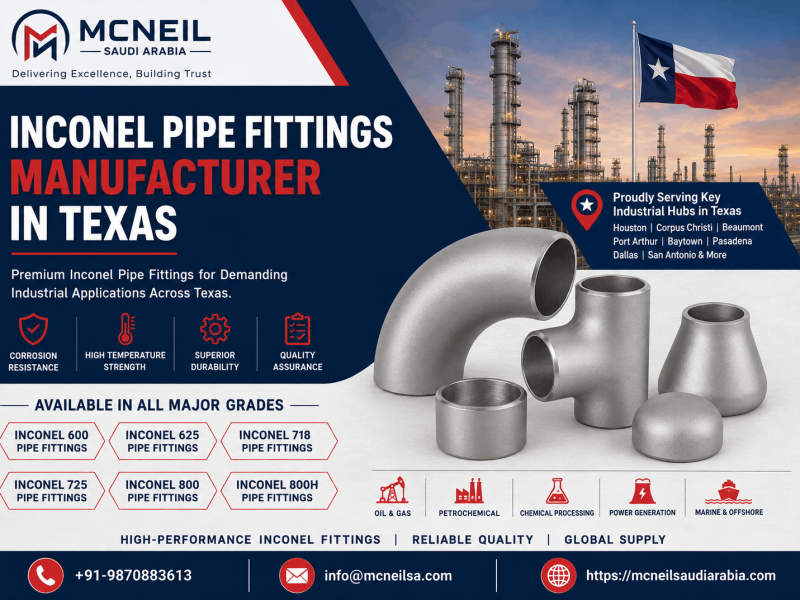
Inconel pipe fittings are widely selected for piping systems that require high strength, corrosion resistance, oxidation resistance, and reliable performance under demanding operating conditions. Industries across Texas, particularly oil and gas, petrochemical, refining, chemical processing, power generation, and advanced manufacturing, require piping components that can withstand aggressive environments and elevated temperatures.
Mcneil Saudi Arabia supplies nickel alloy and Inconel pipe fittings for industrial applications, including Inconel 600, 625, 718, 725, 800, and 800H grades. These fittings can be supplied in configurations such as elbows, tees, reducers, caps, crosses, and other pipe fitting designs according to applicable specifications and project requirements.
Texas is one of the most important energy and industrial markets in the United States. The state leads the nation in oil and gas production and has a major petrochemical and refining industry. Its industrial base creates demand for high-performance alloy components for processing facilities, pipelines, refineries, chemical plants, and other critical applications.
This guide explains the major Inconel pipe fitting grades, applications, specifications, fitting types, and factors Texas buyers should consider when selecting an Inconel pipe fittings manufacturer or supplier.
What Are Inconel Pipe Fittings?
Inconel pipe fittings are components manufactured from nickel-based alloys designed for demanding piping environments. Depending on the grade, Inconel alloys can provide combinations of high-temperature strength, corrosion resistance, oxidation resistance, and resistance to various aggressive process environments.
Pipe fittings are used to connect, redirect, branch, reduce, or terminate piping systems. Common configurations include elbows, tees, reducers, caps, crosses, and stub ends.
The appropriate Inconel grade depends on the operating temperature, pressure, chemical environment, mechanical requirements, applicable specifications, and intended service.
Nickel-based fittings can be particularly useful where conventional carbon steel or stainless steel materials may not provide the required combination of corrosion resistance and high-temperature performance.
Why Are Inconel Alloys Used for Industrial Piping?
Inconel grades are selected for demanding applications because different compositions provide specialized performance characteristics.
Typical considerations include:
- High-temperature service
- Oxidation resistance
- Corrosion resistance
- High mechanical strength
- Resistance to chloride-containing environments
- Resistance to localized corrosion
- Long-term performance in demanding process systems
- Compatibility with specialized industrial applications
The exact properties vary significantly between Inconel 600, 625, 718, 725, 800, and 800H, so material selection should always be based on the actual service conditions.
Why Choose Inconel Pipe Fittings in Texas?
Texas has one of the largest industrial and energy economies in the United States. The state’s energy sector includes oil and gas extraction, production, transportation, refining, petrochemicals, LNG, power generation, and related manufacturing.
Texas also has a major concentration of petroleum refining and chemical manufacturing. According to the Texas government, the state processes almost 6.3 million barrels of crude oil per day and has the largest petrochemical cluster in the nation.
These industries frequently require piping components capable of operating in corrosive, high-temperature, high-pressure, or otherwise demanding environments.
Inconel Fittings for Houston and Texas Industrial Markets
Houston is particularly important for Inconel pipe fitting demand because of its concentration of energy, petrochemical, refining, engineering, and manufacturing companies. The Houston region has a major energy ecosystem covering exploration, production, pipelines, offshore services, chemical manufacturing, and related industries.
Other Texas markets that may require nickel alloy pipe fittings include:
- Corpus Christi
- Beaumont
- Port Arthur
- Baytown
- Pasadena
- Freeport
- Texas City
- Dallas
- Fort Worth
- San Antonio
- Midland
- Odessa
Petrochemical and refining activity is particularly concentrated around Houston and the Beaumont-Port Arthur area, while other manufacturing and energy activities are distributed throughout the state.
Inconel Pipe Fittings Grades Available in Texas
Different Inconel grades are designed for different combinations of corrosion resistance, strength, and temperature capability. The six grades covered in this guide are Inconel 600, 625, 718, 725, 800, and 800H.
Inconel 600 Pipe Fittings in Texas
The Inconel 600 is a nickel-chromium alloy known for its resistance to corrosion and oxidation and its useful performance across a broad temperature range.
Inconel 600 pipe fittings can be considered for applications involving chemical processing, heat treatment, furnace equipment, and other industrial systems where resistance to corrosive environments and elevated temperatures is important.
Typical fittings include elbows, tees, reducers, caps, and other configurations required for process piping.
For Texas buyers, Inconel 600 fittings may be relevant to chemical processing plants, industrial heating equipment, refinery-related applications, and other facilities where corrosion and temperature are important design considerations.
When purchasing Inconel 600 pipe fittings, buyers should confirm the required material specification, dimensions, wall thickness, manufacturing method, heat treatment, inspection requirements, and documentation.
Inconel 625 Pipe Fittings in Texas
Inconel 625 is a nickel-chromium-molybdenum alloy recognized for its combination of corrosion resistance and mechanical strength.
The alloy is widely associated with demanding environments where resistance to pitting, crevice corrosion, and other forms of corrosion is important. This makes Inconel 625 an attractive option for selected oil and gas, chemical processing, marine, offshore, and industrial applications.
Inconel 625 pipe fittings in Texas can be used where piping systems require a high-performance nickel alloy rather than a conventional stainless steel or carbon steel fitting.
Typical products include:
- Inconel 625 elbows
- Inconel 625 tees
- Inconel 625 reducers
- Inconel 625 caps
- Inconel 625 butt weld fittings
For oil and gas applications, the final grade and specification should be selected according to the process fluid, pressure, temperature, corrosion environment, and applicable project requirements.
Inconel 718 Pipe Fittings in Texas
Inconel 718 is a high-strength nickel-chromium alloy designed to provide excellent mechanical properties, including high strength at elevated temperatures.
The alloy is particularly well known in aerospace and high-performance applications, but nickel-based high-strength materials can also be relevant to specialized industrial equipment and power generation environments.
Inconel 718 pipe fittings in Texas may be considered for applications where mechanical strength and elevated-temperature performance are important design requirements.
Potential application areas include:
- Power generation
- High-temperature equipment
- Gas turbine-related systems
- Aerospace-related manufacturing
- Specialized industrial equipment
Because Inconel 718 is a precipitation-hardening alloy, buyers should carefully specify the required condition, heat treatment, dimensions, and applicable material requirements when ordering fittings.
Inconel 725 Pipe Fittings in Texas
Inconel 725 is a high-strength nickel-based alloy offering a combination of corrosion resistance and mechanical strength.
It is particularly associated with demanding oil and gas and offshore applications where high strength and resistance to aggressive environments are important.
Inconel 725 pipe fittings in Texas may be specified for specialized piping and equipment applications in the energy sector, especially where conventional materials do not provide the required performance.
Potential applications include:
- Oil and gas equipment
- Offshore systems
- High-pressure applications
- Corrosive service environments
- Specialized energy-sector equipment
When specifying Inconel 725 fittings, purchasers should consider temperature, pressure, fluid chemistry, required mechanical properties, applicable standards, and project-specific requirements.
Inconel 800 Pipe Fittings in Texas
The Inconel 800 is a nickel-iron-chromium alloy developed for applications where resistance to oxidation, carburization, and elevated-temperature environments is important.
Inconel 800 pipe fittings can be considered for high-temperature industrial systems, heat exchangers, petrochemical equipment, chemical processing systems, and heating equipment.
Texas has a substantial petrochemical and chemical manufacturing base, making high-temperature nickel alloy products relevant to selected industrial applications. The state’s industrial chemical sector includes petrochemical, industrial gas, and other chemical manufacturing activities.
Inconel 800 fittings may be manufactured or supplied in configurations such as:
- Elbows
- Tees
- Reducers
- Caps
- Cross fittings
- Other custom configurations
The correct specification should be confirmed according to the required application and applicable material standard.
Inconel 800H Pipe Fittings in Texas
Inconel 800H is a higher-temperature version of the 800 alloy family, with properties intended for demanding elevated-temperature service.
One of the key considerations when selecting 800H is its suitability for applications where creep and rupture performance at elevated temperatures becomes important.
Inconel 800H pipe fittings can be considered for selected high-temperature petrochemical, chemical processing, heat exchanger, furnace, and industrial applications.
For Texas industrial facilities operating at elevated temperatures, 800H may be considered when the application requires more demanding high-temperature performance than a standard 800-grade application.
Buyers should clearly identify the required grade as Inconel 800H rather than simply specifying “Inconel 800,” because the material requirements and intended service conditions can differ.
Types of Inconel Pipe Fittings
An Inconel pipe fittings manufacturer can supply different fitting configurations depending on the piping design and applicable specifications.
Inconel Elbows
Inconel elbows are used to change the direction of a piping system. Common configurations include 45-degree and 90-degree elbows, with long-radius designs used in many process piping applications.
Inconel Tees
Inconel tees are used to create branches within piping systems. Equal tees have the same nominal connection size, while reducing tees provide a branch connection of a different size.
Inconel Reducers
Reducers connect pipes of different diameters. Concentric reducers maintain a common centerline, while eccentric reducers offset the centerline and can be selected according to piping design requirements.
Inconel Caps and Other Fittings
Inconel pipe caps are used to close the end of a pipe or piping component. Other available configurations may include crosses, stub ends, couplings, and specially engineered fittings.
The actual availability, dimensions, manufacturing method, and material specification should be confirmed with the supplier for each project.
Inconel Pipe Fittings Specifications and Standards
When purchasing Inconel pipe fittings, material grade alone is not enough. Buyers should provide complete technical requirements to ensure the fittings are suitable for the intended piping system.
Important purchasing details may include:
- Inconel grade
- Nominal pipe size
- Wall thickness
- Schedule
- Fitting type
- End connection
- Seamless or welded construction
- Heat treatment
- Dimensional requirements
- Pressure requirements
- Surface condition
- Inspection requirements
- Material Test Certificate
- Positive Material Identification where required
- Third-party inspection where specified
ASTM and ASME Requirements
Depending on the specific product, grade, fitting configuration, and application, ASTM and ASME requirements may apply.
It is important not to assume that one specification applies to every Inconel grade and every fitting configuration. The applicable specification should be confirmed based on the exact product form and project requirements.
For engineered projects, buyers may also require documentation related to chemical composition, mechanical properties, heat treatment, dimensional inspection, PMI, traceability, and testing.
Applications of Inconel Pipe Fittings in Texas
Texas has a broad industrial economy, but energy and chemical industries are especially important markets for high-performance alloy products. Texas identifies energy evolution, oil and gas, advanced manufacturing, petroleum refining, and chemical products among its major industry sectors.
Oil and Gas Industry
Inconel fittings can be considered for selected oil and gas applications where corrosion resistance, strength, or temperature performance is important.
Potential applications include:
- Oil and gas processing
- Gas processing systems
- Refinery piping
- Offshore equipment
- Pipeline-related systems
- High-temperature process equipment
Houston remains one of the most important energy centers in the United States, with extensive oil and gas, pipeline, engineering, chemical, and manufacturing activity.
Petrochemical and Chemical Processing
Petrochemical plants frequently handle aggressive chemicals, elevated temperatures, and demanding process conditions.
Inconel 600, 625, 800, and 800H may be considered for different applications depending on the process environment and engineering requirements.
Power Generation and Industrial Manufacturing
High-temperature nickel alloys can also be used in selected power generation and industrial equipment applications.
Texas has a large and diversified manufacturing economy, including machinery, fabricated metal products, chemical manufacturing, petroleum products, and advanced manufacturing.
LNG, Marine and Offshore Applications
Certain Inconel grades can be suitable for marine, offshore, and LNG-related applications where corrosion resistance and mechanical performance are important.
The exact grade should always be selected based on temperature, pressure, fluid chemistry, environmental exposure, and applicable design requirements.
How to Select the Right Inconel Pipe Fitting Grade
Selecting an Inconel pipe fitting should begin with the operating conditions rather than simply choosing the highest-grade alloy.
| Inconel Grade | Key Characteristics | Typical Application Areas |
|---|---|---|
| Inconel 600 | Corrosion and oxidation resistance | Chemical processing, heat treatment |
| Inconel 625 | Corrosion resistance and strength | Oil & gas, marine, chemical |
| Inconel 718 | High strength at elevated temperatures | Aerospace, power, specialized equipment |
| Inconel 725 | High strength and corrosion resistance | Oil & gas, offshore |
| Inconel 800 | High-temperature oxidation resistance | Petrochemical, heat treatment |
| Inconel 800H | Elevated-temperature creep and rupture performance | High-temperature industrial systems |
Before placing an order, evaluate:
- Operating temperature
- Operating pressure
- Process fluid
- Corrosion environment
- Mechanical requirements
- Piping code
- Material specification
- Required inspection
- Certification and traceability
- Project-specific requirements
For critical systems, material selection should be reviewed by the responsible engineering or materials specialist.
Why Choose Mcneil Saudi Arabia as an Inconel Pipe Fittings Supplier?
Mcneil Saudi Arabia supplies nickel alloy and Inconel pipe fittings for demanding industrial applications and can support buyers requiring different grades, dimensions, configurations, and documentation.
The product range can include Inconel 600, 625, 718, 725, 800, and 800H pipe fittings according to project requirements and availability.
When sourcing Inconel fittings for Texas projects, buyers can request technical information such as:
- Material grade
- Dimensions
- Applicable specification
- Chemical composition
- Mechanical properties
- Heat treatment requirements
- Material Test Certificate
- Inspection documentation
- PMI requirements
- Packaging requirements
- Export documentation
A reliable supplier should understand that industrial buyers are not simply purchasing a fitting; they are purchasing a material solution that must meet a defined engineering specification.
For quotations, buyers should provide the grade, fitting type, size, schedule, quantity, applicable standard, delivery requirements, and any inspection or certification requirements.
Frequently Asked Questions About Inconel Pipe Fittings
What are Inconel pipe fittings used for?
Inconel pipe fittings are used in demanding piping applications where corrosion resistance, high-temperature performance, oxidation resistance, or mechanical strength is important. Applications can include oil and gas, petrochemical, chemical processing, power generation, marine, and specialized industrial systems.
Which Inconel grade is best for oil and gas applications?
There is no single best Inconel grade for every oil and gas application. Inconel 625 and 725 can be considered for various demanding environments, while other grades may be appropriate depending on temperature, corrosion conditions, mechanical requirements, and project specifications.
What is the difference between Inconel 600 and 625?
Inconel 600 is a nickel-chromium alloy known for corrosion and oxidation resistance, while Inconel 625 contains significant molybdenum and is known for a strong combination of corrosion resistance and mechanical strength. The appropriate choice depends on the specific service environment.
What is the difference between Inconel 800 and 800H?
Inconel 800H is intended for more demanding elevated-temperature applications where creep and rupture properties are important. The correct grade should be selected according to operating temperature and the applicable material and design requirements.
Are Inconel pipe fittings suitable for high-temperature applications?
Several Inconel grades are designed for elevated-temperature environments. However, temperature capability varies by grade, material condition, load, environment, and application. Engineering requirements should be reviewed before selecting a fitting.
Can I source Inconel 718 pipe fittings in Texas?
Inconel 718 pipe fittings can be sourced for specialized industrial requirements, subject to grade, dimensions, manufacturing requirements, applicable specification, quantity, and availability.
What standards are used for Inconel pipe fittings?
Applicable standards depend on the alloy grade, product form, fitting type, and project requirements. ASTM and ASME specifications may apply, along with customer-specific, inspection, and quality requirements.
How do I choose an Inconel pipe fittings supplier?
Compare suppliers based on material availability, technical knowledge, applicable specifications, documentation, traceability, inspection support, manufacturing capabilities, packaging, and export experience. Providing complete technical requirements helps the supplier offer the correct product.
Conclusion
Inconel pipe fittings are engineered for applications where conventional materials may not provide the required combination of corrosion resistance, high-temperature performance, and mechanical strength. For industrial buyers in Texas, selecting the correct Inconel grade is particularly important because the state has extensive oil and gas, refining, petrochemical, chemical processing, power, and manufacturing activities.
Mcneil Saudi Arabia supplies Inconel 600, 625, 718, 725, 800, and 800H pipe fittings for industrial requirements. Each grade offers different characteristics, making it important to evaluate temperature, pressure, corrosion conditions, mechanical requirements, applicable standards, and project specifications before purchasing.
If you are looking for an Inconel Pipe Fittings Manufacturer in Texas or require supply support for a Texas industrial project, provide your required grade, fitting type, size, schedule, quantity, specification, and inspection requirements to obtain the appropriate quotation and technical documentation.
Recent Comments