
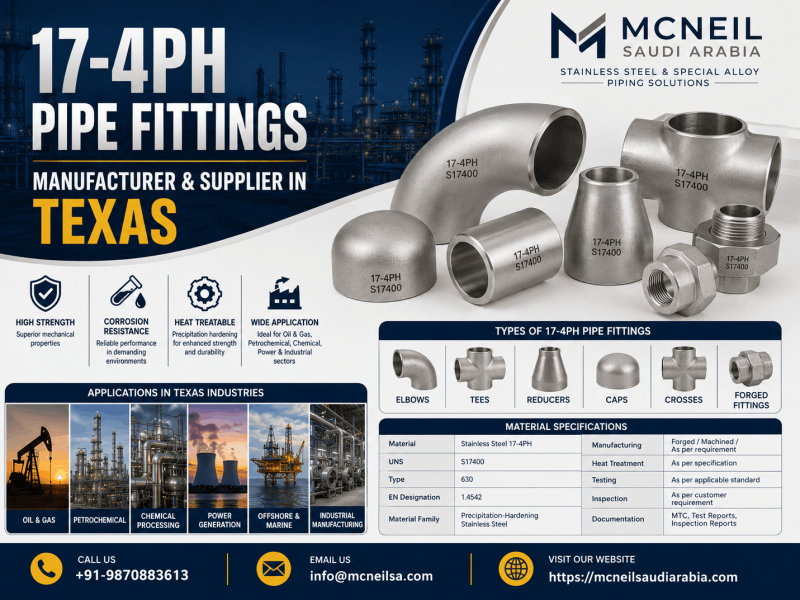
When industrial piping systems require a combination of high mechanical strength, corrosion resistance, and reliable performance, 17-4PH stainless steel pipe fittings can be an important material option. Also identified as UNS S17400, Type 630, and EN 1.4542, 17-4PH is a precipitation-hardening stainless steel used for components where strength is a major design consideration.
Texas is one of the most important industrial and energy markets in the United States. The state leads the nation in oil and gas production and has the largest petrochemical workforce cluster in the country. Its industrial base includes oil and gas extraction, transportation, petroleum refining, chemical manufacturing, power generation, and advanced manufacturing.
For these demanding applications, selecting the correct pipe fitting material, dimensions, manufacturing method, heat-treatment condition, and applicable specification is essential. Mcneil Saudi Arabia supplies stainless steel and specialty alloy piping products for industrial buyers and can assist customers looking for 17-4PH pipe fittings for projects in Texas.
What Are 17-4PH Stainless Steel Pipe Fittings?
17-4PH stainless steel is a precipitation-hardening stainless steel developed to provide a useful combination of high strength and corrosion resistance. The material is commonly known by its UNS designation S17400 and Type 630 designation.
Unlike conventional austenitic stainless steels such as 304 and 316, 17-4PH achieves high mechanical strength through a controlled heat-treatment process. This makes it attractive for components where strength and dimensional stability are important.
17-4PH pipe fittings can be manufactured in different configurations depending on the piping system and project requirements. These may include elbows, tees, reducers, caps, crosses, couplings, and other forged or machined components.
Engineers should select the appropriate product specification based on the actual fitting type, manufacturing route, dimensions, pressure and temperature requirements, and applicable project standards.
Understanding UNS S17400 and Type 630
The terms 17-4PH, UNS S17400, and Type 630 are commonly used to identify the same precipitation-hardening stainless steel family.
The “17-4” designation is associated with the approximate chromium and nickel content of the alloy, while “PH” refers to precipitation hardening.
ASTM documentation identifies Type 630 as an age-hardening stainless steel and recognizes solution-annealed and age-hardened conditions for applications that require a combination of corrosion resistance and high mechanical strength.
Why Is 17-4PH Used for Industrial Fittings?
The main attraction of 17-4PH is its ability to provide high mechanical strength while retaining useful corrosion resistance for appropriate service environments.
Engineers can consider 17-4PH for industrial components that face demanding mechanical loads, pressure service, and challenging process environments, depending on the specified material condition and application requirements.
However, material selection should always consider the complete service environment. Chloride exposure, temperature, chemicals, pressure, welding requirements, and other operating conditions can influence whether 17-4PH is appropriate.
Key Properties of 17-4PH Pipe Fittings
Understanding the material properties of 17-4PH helps engineers and procurement teams determine whether it is suitable for a particular piping application.
High Mechanical Strength
One of the major advantages of 17-4PH stainless steel is its ability to achieve high mechanical strength through precipitation hardening.
This makes the material attractive for components that need greater strength than may be available from many conventional stainless steel grades.
For pipe fittings, this can be important when the component must withstand mechanical loading, pressure-related stresses, vibration, or other demanding service conditions.
Good Corrosion Resistance
17-4PH provides useful corrosion resistance in many industrial environments. Its chromium content contributes to its stainless-steel corrosion resistance.
However, corrosion resistance is application-specific. Engineers should not automatically use 17-4PH as a replacement for highly corrosion-resistant grades such as duplex or super duplex stainless steels in every chloride-rich or marine application.
A qualified material selection process should consider the actual chemical composition of the process fluid and the operating environment.
Precipitation-Hardening Capability
The precipitation-hardening process allows 17-4PH to develop different combinations of strength and toughness depending on the specified heat-treatment condition.
This flexibility is one reason the material is used for demanding industrial components.
The material can be supplied and processed according to the requirements of the applicable material and product specification.
Dimensional and Mechanical Reliability
For industrial piping systems, fitting dimensions, wall thickness, end preparation, material condition, and manufacturing quality all influence installation and service performance.
A reliable supplier should therefore provide products according to the customer’s specified dimensions and documentation requirements rather than treating every 17-4PH fitting as an identical product.
Types of 17-4PH Pipe Fittings Available
A piping system may require multiple fitting configurations depending on changes in direction, diameter, branching, and termination.
17-4PH Elbows
17-4PH elbows are used to change the direction of a piping system. Common configurations include 45-degree and 90-degree elbows, depending on the piping design.
Elbows may be selected for applications where high strength and corrosion resistance are required.
17-4PH Tees
17-4PH tees allow a branch connection to be created within a piping system.
Depending on the design, equal tees and reducing tees may be required. Correct dimensions and end connections should be confirmed before ordering.
17-4PH Reducers
Reducers connect piping sections with different nominal diameters.
Common configurations include concentric and eccentric reducers. The correct type depends on the piping layout, flow requirements, and engineering design.
17-4PH Pipe Caps
Pipe caps are used to close the end of a pipe or piping section.
Industries use these fittings in various piping and equipment applications that require strong, corrosion-resistant stainless-steel components.
17-4PH Crosses
Cross fittings provide multiple branch connections from a central fitting.
They may be required in specialized piping arrangements where multiple flow paths need to connect at a single location.
17-4PH Forged Fittings
Forged fittings can include configurations such as couplings, unions, bushings, socket-weld fittings, and threaded fittings, depending on the project requirements.
For forged products, buyers should confirm the applicable material specification, pressure class, dimensions, connection type, and testing requirements.
17-4PH Pipe Fittings Specifications and Standards
For industrial procurement, material grade alone is not enough. Buyers should identify the complete product specification before placing an order.
Typical purchasing information can include:
| Specification | Typical Requirement |
|---|---|
| Material | Stainless Steel 17-4PH |
| UNS | S17400 |
| Type | 630 |
| EN Designation | 1.4542 |
| Product Type | Butt-weld / forged / machined as applicable |
| Dimensions | According to applicable dimensional standard |
| Heat Treatment | As specified by material/product requirement |
| Testing | According to applicable specification |
| Inspection | As required by customer/project |
| Documentation | Material and inspection documents as specified |
ASTM and ASME Requirements
A critical point for buyers is that not every stainless-steel fitting automatically falls under the same ASTM specification.
ASTM A403 specifically covers wrought austenitic stainless-steel piping fittings, so engineers should not present it as a universal specification for 17-4PH fittings. They should instead verify the applicable material standard based on the fitting type, grade, manufacturing method, and project requirements.
Similarly, ASTM A564/A564M covers hot-rolled and cold-finished age-hardening stainless-steel bars and shapes, including Type 630 material, and allows solution-annealed or age-hardened conditions. It is important to distinguish the material specification from the finished fitting specification.
For this reason, purchasers should provide the supplier with the exact product form and project specification. The manufacturer and buyer should confirm the applicable ASTM, ASME, MSS, dimensional, testing, and inspection requirements before starting manufacturing or supply.
This approach reduces the risk of ordering a product under an unsuitable specification.
Applications of 17-4PH Pipe Fittings in Texas
Texas is a particularly important market for industrial piping products because of its large energy, refining, chemical, manufacturing, and transportation infrastructure.
The Texas Office of the Governor identifies oil and gas extraction, production and transportation as a major target industry cluster. Texas also leads the nation in petroleum refining and is a major center for petrochemical and chemical production.
Oil and Gas Industry
Oil and gas facilities use a wide variety of piping components, valves, fittings, flanges, and specialty alloy products.
17-4PH fittings may be considered for selected applications where a combination of mechanical strength and corrosion resistance is required.
Material selection should be based on the actual service conditions rather than simply choosing a fitting because it is classified as stainless steel.
Petroleum Refining
Texas has an extensive petroleum-refining industry. According to the Texas Office of the Governor, the state processes almost 6.3 million barrels of crude oil per day and represents approximately one-third of U.S. refining capacity.
Refineries require piping systems and equipment capable of operating under demanding process conditions. The correct fitting material must be selected based on pressure, temperature, chemical exposure, and applicable engineering specifications.
Petrochemical and Chemical Processing
Petrochemical and chemical plants represent another important market for specialty stainless-steel fittings.
Texas has the largest petrochemical workforce cluster in the United States, with particularly strong activity around the Houston area.
17-4PH fittings may be considered for selected equipment and piping applications where high strength is an important design requirement.
Power Generation
Power-generation facilities use extensive piping systems for water, steam, cooling, fuel, and auxiliary services.
Depending on the system, 17-4PH components may be considered where the material’s strength and corrosion characteristics match the application.
Industrial Manufacturing
Texas also has a broad advanced manufacturing sector. Industrial equipment manufacturers may require high-strength stainless-steel components for machinery, processing equipment, and specialized systems.
The correct fitting configuration, material condition, and dimensional requirements should be established during engineering and procurement.
Why Choose 17-4PH Pipe Fittings for Texas Industries?
Selecting a pipe fitting material is a balance between performance, operating environment, availability, cost, and project requirements.
High Strength-to-Performance Combination
17-4PH can offer a valuable combination of high mechanical strength and corrosion resistance.
This makes it attractive for selected applications where conventional stainless steels may not provide the desired strength level.
Heat-Treatment Flexibility
The precipitation-hardening characteristics of 17-4PH allow its mechanical properties to be adjusted through controlled heat-treatment conditions.
This should be specified carefully because the final properties depend on the material condition and applicable requirements.
Suitable for Demanding Industrial Applications
Texas’ energy and industrial sectors include some of the most demanding operating environments in the United States.
Texas currently identifies energy, petroleum refining, chemicals, advanced manufacturing, transportation, and other industries as important economic sectors.
For applications where 17-4PH is technically suitable, the material can provide an attractive combination of strength and corrosion resistance.
17-4PH Pipe Fittings Manufacturer & Supplier Texas
When purchasing 17-4PH pipe fittings in Texas, buyers should look beyond price and confirm material traceability, product specifications, dimensions, testing, inspection, and documentation.
Mcneil Saudi Arabia supplies stainless steel and specialty alloy piping products for industrial and international customers.
As a supplier and exporter, Mcneil Saudi Arabia can assist buyers with requirements for 17-4PH pipe fittings based on:
- Fitting type
- Nominal pipe size
- Wall thickness or schedule
- Material grade
- Heat-treatment condition
- Applicable specification
- Quantity
- Inspection requirements
- Documentation
- Delivery requirements
Customers looking for 17-4PH pipe fittings in Texas should provide a detailed inquiry so that the required product configuration and applicable standards can be reviewed before quotation.
For inquiries, contact Mcneil Saudi Arabia at info@mcneilsa.com or visit mcneilsaudiarabia.com.
17-4PH Pipe Fittings Supplier in Houston, Dallas and Across Texas
Texas is a large market, so industrial buyers may search for suppliers using city-specific terms.
17-4PH Pipe Fittings in Houston
Houston is one of the most important industrial markets for 17-4PH and other specialty alloy piping products because of its concentration of energy, refining, petrochemical, chemical, engineering, and manufacturing activities.
Buyers searching for a 17-4PH pipe fittings supplier in Houston should evaluate material documentation, product specifications, inspection capabilities, and delivery requirements.
17-4PH Pipe Fittings in Dallas
Dallas and the surrounding North Texas region have extensive industrial, manufacturing, engineering, and distribution activity.
17-4PH fittings may be required for machinery, industrial systems, energy-related equipment, and specialized piping applications.
17-4PH Pipe Fittings in San Antonio
San Antonio serves a broad industrial and energy-related market. Buyers can specify 17-4PH fittings according to their project drawings, piping specifications, and required material documentation.
17-4PH Pipe Fittings in Austin
Austin’s growing manufacturing, technology, and industrial ecosystem can also create demand for specialty materials and engineered components.
Mcneil Saudi Arabia can support inquiries from buyers across Texas, including Houston, Dallas, San Antonio, Austin, Fort Worth, Corpus Christi, Beaumont, Midland, and Odessa.
How to Select the Right 17-4PH Pipe Fittings
Before purchasing, buyers should provide complete technical information.
1. Confirm the Material Grade
Specify 17-4PH, UNS S17400, or the project-required material designation.
2. Select the Fitting Type
Identify whether the requirement is an elbow, tee, reducer, cap, cross, coupling, or another fitting.
3. Confirm Size and Wall Thickness
Provide nominal pipe size, schedule, wall thickness, or drawing information.
4. Confirm the Connection Type
Specify butt-weld, socket-weld, threaded, or another connection configuration where applicable.
5. Confirm Heat-Treatment Requirements
Because 17-4PH is a precipitation-hardening stainless steel, the required material condition should be clearly stated.
6. Specify Testing and Documentation
Depending on the project, buyers may require chemical analysis, mechanical testing, hardness testing, dimensional inspection, visual examination, PMI, MTCs, or third-party inspection.
7. Confirm Delivery Requirements
For Texas projects, provide the delivery location, required quantity, packaging requirements, and project schedule.
A complete inquiry allows the supplier to identify the appropriate product and provide a more accurate quotation.
Frequently Asked Questions About 17-4PH Pipe Fittings
What is 17-4PH stainless steel?
17-4PH is a precipitation-hardening stainless steel commonly designated as UNS S17400 and Type 630. It is known for combining high mechanical strength with useful corrosion resistance.
What is the UNS number of 17-4PH?
The commonly used UNS designation for 17-4PH stainless steel is UNS S17400.
Is 17-4PH stainless steel corrosion resistant?
Yes, 17-4PH provides useful corrosion resistance for many industrial applications. However, the suitability of the grade depends on the specific chemical environment, temperature, chloride exposure, stress conditions, and other service requirements.
What are 17-4PH pipe fittings used for?
17-4PH fittings can be considered for selected oil and gas, petrochemical, chemical processing, power generation, industrial manufacturing, and other demanding applications where high strength is an important requirement.
What types of 17-4PH fittings are available?
Depending on the manufacturing method and project requirements, available configurations can include elbows, tees, reducers, caps, crosses, couplings, socket-weld fittings, threaded fittings, and other specialized components.
Are 17-4PH fittings available for Houston projects?
Yes, industrial buyers in Houston and other Texas locations can source 17-4PH fittings through suppliers and exporters. Product availability, dimensions, specifications, and delivery should be confirmed for each project.
What standards apply to 17-4PH fittings?
The applicable standard depends on the fitting’s product form, manufacturing process, dimensions, service requirements, and customer specification. Buyers should confirm the correct ASTM, ASME, dimensional, testing, and inspection requirements before ordering.
How can I request a quotation for 17-4PH pipe fittings?
Provide the fitting type, size, schedule or wall thickness, material designation, quantity, applicable specification, heat-treatment condition, testing requirements, documentation requirements, and delivery location. This information helps the supplier prepare an accurate quotation.
Conclusion
17-4PH pipe fittings offer a combination of high mechanical strength and corrosion resistance that can make them suitable for selected demanding industrial applications. With its identification as UNS S17400 and Type 630, 17-4PH is an important precipitation-hardening stainless steel for applications where material strength is a significant consideration.
Texas provides a strong market for specialty piping products because of its extensive oil and gas, refining, petrochemical, chemical, energy, and manufacturing industries. The state’s economic development office continues to identify energy and petroleum refining and chemicals as major industry sectors.
For buyers searching for a 17-4PH pipe fittings manufacturer and supplier in Texas, the key is to select products according to the actual application, fitting configuration, material condition, dimensions, applicable standards, testing, and documentation requirements.
Mcneil Saudi Arabia can assist industrial buyers with 17-4PH and other stainless-steel and specialty alloy piping requirements.
Email: info@mcneilsa.com
Website: mcneilsaudiarabia.com
Recent Comments