
Introduction
The demand for industrial piping components has grown significantly in the Middle East, making carbon steel pipe fittings export to Saudi Arabia a lucrative opportunity for global manufacturers and suppliers. As one of the largest economies in the Gulf region, Saudi Arabia continues to invest heavily in infrastructure, oil & gas, and petrochemical industries, all of which rely on high-quality piping systems.
Major industrial hubs such as Dammam, Riyadh, and Jeddah are witnessing rapid development, increasing the need for durable and cost-effective piping solutions. Carbon steel pipe fittings play a crucial role in these sectors due to their strength, versatility, and affordability.
In this article, we will explore everything you need to know about exporting carbon steel pipe fittings to Saudi Arabia, including types, standards, applications, and key considerations for suppliers.
What Are Carbon Steel Pipe Fittings?
Carbon steel pipe fittings are components used to connect, redirect, or terminate pipelines in various industrial systems. These fittings are manufactured using carbon steel, a material composed primarily of iron and carbon, known for its high strength and durability.
They are widely used in industries where high pressure and temperature conditions are common. Carbon steel fittings can be either seamless or welded, depending on the manufacturing process. Seamless fittings offer superior strength, while welded fittings are more cost-effective for large-scale applications.
Due to their mechanical properties and affordability, carbon steel pipe fittings are a preferred choice for large industrial projects in Saudi Arabia.
Types of Carbon Steel Pipe Fittings
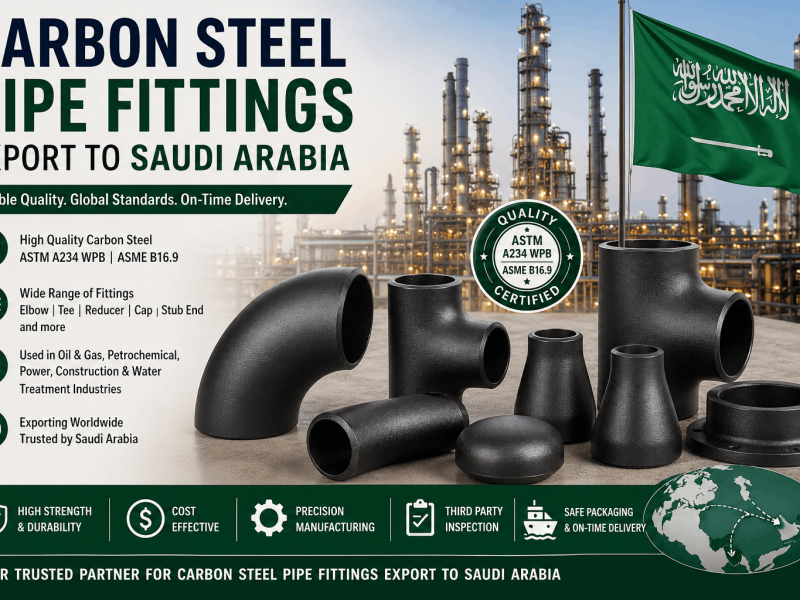
Elbows (45°, 90°, 180°)
Elbows are used to change the direction of flow in a piping system. They are available in different angles, with 90° and 45° being the most common. These fittings are essential in complex pipeline layouts.
Tees (Equal & Reducing)
Tees are used to branch off a pipeline into two directions. Equal tees have the same diameter on all ends, while reducing tees allow for different pipe sizes.
Reducers (Concentric & Eccentric)
Reducers are used to connect pipes of different diameters. Concentric reducers maintain a uniform centerline, while eccentric reducers are used to prevent air accumulation in pipelines.
Caps & Stub Ends
Caps are used to seal the end of a pipe, while stub ends are used in conjunction with flanges for easy disassembly and maintenance.
Key Standards & Specifications
When exporting carbon steel pipe fittings to Saudi Arabia, compliance with international standards is essential. Some of the most widely used standards include:
- ASTM A234 WPB – Standard specification for carbon steel fittings
- ASME B16.9 – Factory-made wrought buttwelding fittings
- ANSI Standards – Dimensional and pressure ratings
These standards ensure that the fittings meet quality, safety, and performance requirements for industrial use. Buyers in Saudi Arabia often require material test certificates and third-party inspection reports.
Applications in Saudi Arabia
Oil & Gas Industry
Saudi Arabia is a global leader in oil production, and carbon steel pipe fittings are extensively used in pipelines, refineries, and offshore platforms.
Petrochemical Plants
These fittings are essential for transporting chemicals under high pressure and temperature conditions.
Construction & Infrastructure
From commercial buildings to large-scale infrastructure projects, carbon steel fittings are used in water supply and HVAC systems.
Power & Desalination Plants
Desalination facilities and power plants rely on robust piping systems, where carbon steel fittings play a vital role.
Why Export Carbon Steel Pipe Fittings to Saudi Arabia?
Saudi Arabia offers a strong market for industrial products due to its ongoing economic diversification under Vision 2030. The country continues to invest in mega projects, increasing the demand for high-quality piping materials.
Additionally, the reliance on imports for specialized industrial components makes it an attractive destination for exporters. Competitive pricing, consistent quality, and timely delivery are key factors for success in this market.
Export Process to Saudi Arabia
Documentation
Exporters must prepare essential documents such as:
- Commercial invoice
- Packing list
- Certificate of origin
Quality & Inspection
Third-party inspections and material test certificates are often required to ensure compliance with Saudi standards.
Packaging & Shipping
Proper packaging is crucial to prevent damage during transit. Fittings are usually coated with anti-rust oil and packed in wooden crates.
Customs & Regulations
Compliance with Saudi regulations, including SASO certification, is mandatory for smooth customs clearance.
Advantages of Carbon Steel Pipe Fittings
- High strength and durability
- Cost-effective compared to stainless steel
- Suitable for high-pressure applications
- Easily available in bulk quantities
These advantages make carbon steel fittings a preferred choice for large-scale industrial projects.
Choosing the Right Exporter
Selecting a reliable exporter is critical for ensuring product quality and timely delivery. Key factors to consider include:
- Experience in exporting to Saudi Arabia
- Compliance with international standards
- Competitive pricing
- Strong logistics network
- Customer support and after-sales service
Pricing Factors for Export
The cost of carbon steel pipe fittings depends on several factors:
- Raw material prices
- Type and size of fittings
- Order quantity
- Shipping and logistics costs
Bulk orders often result in better pricing, making them ideal for large projects.
Carbon Steel vs Stainless Steel Pipe Fittings
While carbon steel fittings are cost-effective and strong, stainless steel fittings offer superior corrosion resistance. In Saudi Arabia, carbon steel is commonly used in oil & gas and construction, while stainless steel is preferred in corrosive environments such as marine and chemical industries.
Challenges in Exporting to Saudi Arabia
Exporters may face challenges such as:
- Strict regulatory requirements
- Complex documentation processes
- Logistics and shipping delays
- High quality expectations
Proper planning and compliance can help overcome these challenges.
Future Demand in Saudi Arabia
With ongoing infrastructure development and expansion in the energy sector, the demand for carbon steel pipe fittings in Saudi Arabia is expected to grow steadily. The country’s focus on industrial diversification further strengthens its position as a key import market.
Frequently Asked Questions (FAQs)
Q1: What are carbon steel pipe fittings?
Carbon steel pipe fittings are components used to connect, redirect, or terminate pipelines. They are made from carbon steel and are widely used in industrial piping systems due to their strength and durability.
Q2: Why is there high demand for carbon steel pipe fittings in Saudi Arabia?
Saudi Arabia has a strong oil & gas, petrochemical, and infrastructure sector. Industrial cities like Dammam, Riyadh, and Jeddah require large volumes of pipe fittings for pipelines and construction projects.
Q3: What is ASTM A234 WPB in carbon steel fittings?
ASTM A234 WPB is a standard specification for carbon steel pipe fittings used in moderate and high-temperature services. It is one of the most commonly used grades for industrial applications.
Q4: Which industries use carbon steel pipe fittings in Saudi Arabia?
Carbon steel pipe fittings are widely used in:
- Oil & gas industry
- Petrochemical plants
- Power generation
- Construction and infrastructure
Q5: How can I export carbon steel pipe fittings to Saudi Arabia?
To export successfully, you need:
- Commercial invoice and packing list
- Certificate of origin
- Compliance with SASO regulations
- Third-party inspection and test certificates
Q6: What are the common types of carbon steel pipe fittings?
The most common types include:
- Elbows (45°, 90°, 180°)
- Tees (equal and reducing)
- Reducers (concentric and eccentric)
- Caps and stub ends
Q7: What are the advantages of carbon steel pipe fittings?
- High strength and durability
- Cost-effective solution
- Suitable for high-pressure systems
- Easily available in bulk
Q8: What is the difference between carbon steel and stainless steel fittings?
Carbon steel fittings are strong and affordable but less corrosion-resistant, while stainless steel fittings offer better corrosion resistance but are more expensive.
Q9: What certifications are required for Saudi Arabia?
Exporters must comply with:
- SASO (Saudi Standards)
- Material Test Certificates (MTC)
- Third-party inspection reports
Q10: How to choose the best carbon steel pipe fittings supplier?
Look for:
Reliable delivery and logistics
Experience in exporting to Saudi Arabia
Compliance with ASTM and ASME standards
Competitive pricing
Conclusion
The market for carbon steel pipe fittings export to Saudi Arabia continues to expand, driven by industrial growth and infrastructure development. With strong demand across key sectors such as oil & gas and construction, exporters have significant opportunities to establish a presence in this region.
By ensuring compliance with international standards, maintaining product quality, and understanding market requirements, suppliers can successfully tap into the Saudi Arabian market and achieve long-term growth.
Recent Comments