
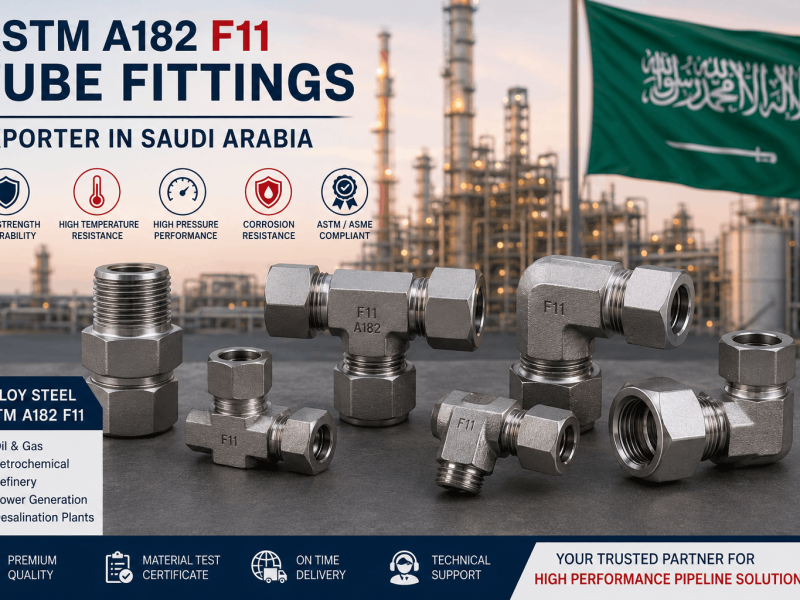
Introduction to ASTM A182 F11 Tube Fittings in Saudi Arabia
High-pressure and high-temperature industrial piping systems widely use ASTM A182 F11 tube fittings as high-performance alloy steel fittings. Manufacturers produce these fittings from chromium-molybdenum (Cr-Mo) alloy steel, which provides excellent strength, durability, and resistance to thermal stress. In Saudi Arabia, demand for ASTM A182 F11 tube fittings is increasing rapidly due to the expansion of oil & gas infrastructure, petrochemical complexes, refineries, and power generation plants.
Saudi Arabia is one of the world’s largest energy producers, and its industrial environment demands materials that can withstand extreme operating conditions. From offshore drilling platforms in the Arabian Gulf to massive refinery complexes in Jubail and Yanbu, reliable piping systems are critical. This is where ASTM A182 F11 tube fittings play a crucial role in ensuring leak-free, safe, and efficient fluid transportation.
The growing industrial projects under Vision 2030 have further boosted demand for high-grade alloy steel fittings. As a result, global exporters and suppliers are actively serving the Saudi market with certified ASTM A182 F11 tube fittings that meet international standards such as ASTM and ASME.
What is ASTM A182 F11 Material?
Manufacturers use ASTM A182 F11, a forged alloy steel grade, to produce flanges, fittings, valves, and other pressure-containing parts. The chromium-molybdenum alloy family provides high-temperature strength and corrosion resistance.
Key Characteristics of ASTM A182 F11:
- Excellent heat resistance up to elevated temperatures
- High tensile strength and creep resistance
- Good weldability and machinability
- Suitable for high-pressure applications
Chemical Composition Overview:
ASTM A182 F11 typically contains:
- Chromium (Cr): Improves oxidation resistance
- Molybdenum (Mo): Enhances strength at high temperatures
- Carbon (C): Provides hardness and strength
- Manganese (Mn): Improves toughness
These elements make F11 ideal for critical industrial applications in harsh environments like Saudi Arabia.
Types of ASTM A182 F11 Tube Fittings
ASTM A182 F11 tube fittings are available in various configurations depending on system design requirements.
Compression Tube Fittings
Compression fittings provide a tight, leak-proof seal and are widely used in instrumentation systems. They are easy to install and maintain, making them suitable for oil & gas pipelines.
Double Ferrule Tube Fittings
Instrumentation lines use these fittings for high-precision sealing. Control systems commonly use them because they provide vibration resistance.
Elbow Tube Fittings
Elbow fittings (45° and 90°) are used to change the direction of flow in piping systems without affecting pressure stability.
Tee Tube Fittings
Tee fittings are used for distributing or combining fluid flow in multiple directions within industrial systems.
Union and Coupling Fittings
These fittings allow easy connection and disconnection of pipe sections without cutting or welding.
Male and Female Connectors
Used for joining tubes and pipes in instrumentation systems, ensuring secure and reliable connections.
ASTM A182 F11 Mechanical Properties and Performance
ASTM A182 F11 fittings are designed to perform under extreme conditions.
Mechanical Properties:
- High tensile strength
- Excellent yield strength
- Good elongation and toughness
- Resistance to thermal fatigue
Performance Advantages:
- Suitable for high-pressure pipelines
- Maintains stability under fluctuating temperatures
- Long service life in aggressive environments
- Reduced maintenance costs
These properties make ASTM A182 F11 tube fittings a preferred choice for Saudi Arabia’s industrial sector.
Features of Alloy Steel ASTM A182 F11 Tube Fittings
ASTM A182 F11 tube fittings offer several performance advantages:
High Pressure Resistance
These fittings are engineered to withstand extremely high pressure conditions in oil, gas, and petrochemical systems.
Corrosion and Oxidation Resistance
In Saudi Arabia’s coastal and desert environments, corrosion resistance is essential. F11 fittings provide reliable performance in such conditions.
Thermal Stability
They maintain mechanical strength even at elevated temperatures commonly found in refineries and power plants.
Leak-Free Operation
Precision engineering ensures tight sealing, reducing the risk of leakage in critical systems.
Long Service Life
Durability reduces replacement frequency and maintenance costs.
Applications of ASTM A182 F11 Tube Fittings in Saudi Arabia
Saudi Arabia’s industrial growth has created strong demand for alloy steel tube fittings in multiple sectors.
Oil & Gas Industry
Upstream and downstream oil & gas operations extensively use ASTM A182 F11 fittings, including pipelines, drilling rigs, and refineries.
Petrochemical Industry
Chemical plants require high-performance fittings to handle corrosive and high-temperature fluids safely.
Power Generation Plants
Used in steam lines, boilers, and high-pressure systems where reliability is critical.
Desalination Plants
Saudi Arabia relies heavily on desalination, where corrosion-resistant fittings are essential for seawater processing systems.
Offshore and Marine Applications
F11 fittings are widely used in offshore oil platforms due to their strength and resistance to harsh marine environments.
ASTM A182 F11 Tube Fittings Exporter in Saudi Arabia
The demand for high-quality ASTM A182 F11 tube fittings in Saudi Arabia has led to increased reliance on global exporters and suppliers who can meet strict quality and delivery standards.
A reliable exporter ensures:
- Compliance with ASTM and ASME standards
- Fast delivery to Saudi industrial hubs
- Availability of certified materials with MTC reports
- Bulk supply capability for EPC and government projects
One such trusted supplier is McNeil Saudi Arabia, which provides a wide range of alloy steel tube fittings for industrial applications across Saudi Arabia. The company supports oil & gas, petrochemical, and construction industries with high-quality, certified products and timely delivery.
Quality Standards and Certifications
Quality assurance is critical when supplying industrial fittings to Saudi Arabia.
ASTM and ASME Compliance
All ASTM A182 F11 tube fittings are manufactured according to international standards ensuring reliability and safety.
Material Test Certificates (MTC)
Each product is supplied with MTC documentation for full traceability of chemical and mechanical properties.
Third-Party Inspection
Inspection agencies such as SGS or TUV can verify product quality before shipment.
Testing Procedures
- Hydrostatic testing
- Ultrasonic testing
- Dimensional inspection
- Hardness testing
These quality checks ensure that the fittings perform reliably under industrial conditions.
Buying Guide for ASTM A182 F11 Tube Fittings
Before purchasing ASTM A182 F11 tube fittings in Saudi Arabia, consider the following factors:
Pressure and Temperature Rating
Ensure fittings are suitable for your system’s operating conditions.
Application Type
Select fittings based on whether they are used in oil & gas, chemical processing, or power generation.
Material Certification
Always verify MTC and compliance certificates.
Supplier Reputation
Choose experienced exporters with proven industrial supply records.
Cost vs Quality Balance
Avoid low-cost, uncertified fittings that may compromise system safety.
Why Saudi Arabia Prefers ASTM A182 F11 Tube Fittings
Saudi Arabia’s industrial sector prefers ASTM A182 F11 fittings because:
- They offer superior strength in extreme heat
- They are suitable for high-pressure environments
- They meet global engineering standards
- They ensure long-term operational reliability
- They reduce downtime in critical systems
These advantages make them essential for EPC contractors and industrial operators.
FAQs – ASTM A182 F11 Tube Fittings Exporter in Saudi Arabia
1. What are ASTM A182 F11 tube fittings used for?
ASTM A182 F11 tube fittings are used in high-pressure and high-temperature piping systems, mainly in oil & gas, petrochemical, power plants, and refinery applications.
2. Why are ASTM A182 F11 fittings popular in Saudi Arabia?
They are widely used in Saudi Arabia because they offer excellent heat resistance, high strength, and reliable performance in harsh desert and industrial environments.
3. What is the difference between ASTM A182 F11 and stainless steel fittings?
ASTM A182 F11 is an alloy steel designed for high-temperature and high-pressure applications, while stainless steel focuses more on corrosion resistance in general environments.
4. Are ASTM A182 F11 tube fittings suitable for oil and gas industry?
Yes, they are highly suitable for oil and gas pipelines, refineries, and offshore platforms due to their strength and durability under extreme conditions.
5. Do exporters provide certification for ASTM A182 F11 fittings?
Yes, reputed exporters provide Material Test Certificates (MTC), compliance with ASTM/ASME standards, and third-party inspection reports when required.
6. What types of ASTM A182 F11 tube fittings are available?
Common types include compression fittings, double ferrule fittings, elbows, tees, unions, and connectors used in industrial piping systems.
7. Who is the best supplier of ASTM A182 F11 tube fittings in Saudi Arabia?
Reliable global exporters and suppliers like McNeil Saudi Arabia provide certified ASTM A182 F11 tube fittings for industrial projects across Saudi Arabia.
Conclusion
ASTM A182 F11 tube fittings are a critical component in Saudi Arabia’s industrial infrastructure. Their ability to withstand high pressure, extreme temperatures, and corrosive environments makes them ideal for oil & gas, petrochemical, and power generation applications.
With increasing industrial expansion across Riyadh, Jubail, Dammam, and Yanbu, the demand for high-quality alloy steel fittings continues to grow. Choosing a reliable exporter ensures long-term performance, safety, and operational efficiency.
Companies like McNeil Saudi Arabia play an important role in supplying certified ASTM A182 F11 tube fittings to meet the needs of Saudi Arabia’s rapidly growing industrial sector.
Recent Comments