
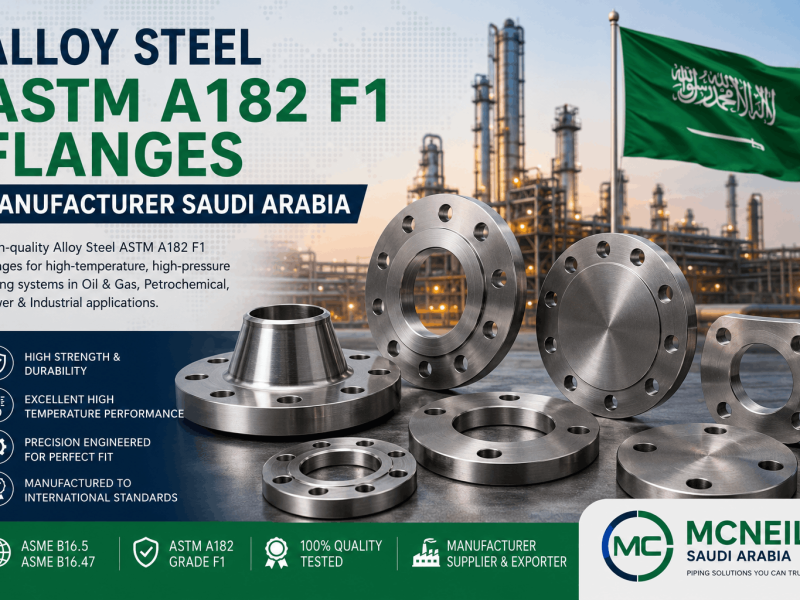
Saudi Arabia is one of the world’s leading industrial economies, driven by extensive investments in oil and gas, petrochemical processing, power generation, desalination, and infrastructure development. These industries require durable and high-performance piping components capable of operating under elevated temperatures and pressures. Among the most trusted solutions for such demanding applications are Alloy Steel ASTM A182 F1 Flanges.
As a leading Alloy Steel ASTM A182 F1 Flanges Manufacturer Saudi Arabia, Mcneil Saudi Arabia supplies premium-quality forged flanges designed to meet international standards and the stringent requirements of industrial projects. ASTM A182 F1 flanges are known for their excellent strength, heat resistance, weldability, and long service life, making them ideal for critical piping systems across Saudi Arabia.
Whether used in refineries, petrochemical complexes, power plants, or offshore installations, ASTM A182 F1 flanges deliver dependable performance and operational safety in challenging environments.
What Are Alloy Steel ASTM A182 F1 Flanges?
Alloy Steel ASTM A182 F1 Flanges are forged pipe flanges manufactured from low-alloy chromium-molybdenum steel in accordance with ASTM A182 specifications. These flanges are engineered for high-temperature and pressure applications where conventional carbon steel may not provide sufficient strength or durability.
The ASTM A182 standard covers forged and rolled alloy steel flanges, fittings, valves, and components intended for elevated-temperature service. Grade F1 contains chromium and molybdenum, which improve mechanical properties and enhance resistance to heat-related degradation.
Understanding ASTM A182 F1 Material
ASTM A182 F1 is a chromium-molybdenum alloy steel specifically developed for applications involving elevated temperatures and pressures. The addition of alloying elements enhances creep resistance and mechanical strength while maintaining good weldability.
Key features include:
- High-temperature strength
- Excellent pressure resistance
- Good weldability
- Improved creep resistance
- Long operational life
- Reliable performance in industrial environments
Key Characteristics of ASTM A182 F1 Flanges
The material’s unique composition allows ASTM A182 F1 flanges to withstand demanding operating conditions commonly found in Saudi Arabian industrial facilities. Their durability and structural integrity make them a preferred choice for engineers and project managers.
Chemical Composition of ASTM A182 F1 Flanges
The performance of ASTM A182 F1 flanges is largely determined by their carefully controlled chemical composition.
Alloying Elements and Their Functions
Carbon
Carbon contributes to strength and hardness while maintaining the required mechanical properties.
Chromium
Chromium improves oxidation resistance, corrosion resistance, and heat resistance.
Molybdenum
Molybdenum enhances tensile strength, creep resistance, and performance at elevated temperatures.
Manganese
Manganese increases toughness and wear resistance.
Silicon
Silicon improves oxidation resistance and overall material stability.
Phosphorus and Sulfur
These elements are controlled within specified limits to ensure optimal mechanical performance and weldability.
Impact of Composition on Performance
The balanced chemical composition enables Alloy Steel ASTM A182 F1 Flanges to perform effectively in:
- High-pressure piping systems
- Steam applications
- Refinery operations
- Petrochemical plants
- Power generation facilities
Mechanical Properties of Alloy Steel ASTM A182 F1 Flanges
Mechanical properties play a critical role in determining the suitability of a flange material for industrial service.
Tensile Strength
ASTM A182 F1 flanges offer excellent tensile strength, enabling them to withstand significant stress without failure.
Yield Strength
The material exhibits reliable yield strength, ensuring dimensional stability under operating loads.
Elongation
Adequate elongation provides flexibility and reduces the risk of cracking during fabrication and service.
Hardness
Controlled hardness levels contribute to wear resistance while maintaining machinability and weldability.
Why Mechanical Properties Matter in Saudi Arabia
Saudi Arabia’s industrial infrastructure often operates under challenging conditions involving:
- High temperatures
- Pressure fluctuations
- Continuous operation cycles
- Aggressive industrial environments
ASTM A182 F1 flanges are specifically designed to handle these conditions while maintaining structural integrity and safety.
Types of ASTM A182 F1 Flanges Available in Saudi Arabia
Various flange designs are available to meet different piping requirements.
ASTM A182 F1 Weld Neck Flanges
Weld neck flanges feature a tapered hub that distributes stress evenly throughout the piping system. They are widely used in high-pressure and high-temperature applications.
Benefits include:
- Superior strength
- Excellent fatigue resistance
- Reliable long-term performance
ASTM A182 F1 Slip-On Flanges
Slip-on flanges are installed by sliding over the pipe and welding both inside and outside.
Advantages include:
- Easy installation
- Lower fabrication costs
- Suitable for moderate-pressure applications
ASTM A182 F1 Blind Flanges
Blind flanges are used to close pipeline ends and pressure vessel openings.
Applications include:
- System maintenance
- Future expansion provisions
- Pressure testing
ASTM A182 F1 Socket Weld Flanges
Socket weld flanges are ideal for smaller pipe sizes and high-pressure services.
ASTM A182 F1 Threaded Flanges
Threaded flanges provide secure connections without welding, making them suitable for certain low-pressure systems.
ASTM A182 F1 Lap Joint Flanges
Lap joint flanges are commonly used where frequent dismantling and maintenance are required.
ASTM A182 F1 Flange Dimensions and Standards
Compliance with international standards ensures compatibility, safety, and performance.
ASME B16.5 Standard
The ASME B16.5 governs dimensions, tolerances, materials, pressure ratings, and testing requirements for flanges up to NPS 24.
ASME B16.47 Standard
ASME B16.47 covers larger flange sizes used in major industrial projects.
ANSI Standards
ANSI standards help maintain consistency and interchangeability across piping systems.
Pressure Classes Available
ASTM A182 F1 flanges are commonly available in:
- Class 150
- Class 300
- Class 600
- Class 900
- Class 1500
- Class 2500
Available Sizes
Standard sizes typically range from:
- ½ inch to 48 inches
- Custom dimensions available upon request
Advantages of Alloy Steel ASTM A182 F1 Flanges
High Temperature Performance
The chromium-molybdenum composition enables reliable performance at elevated temperatures.
Excellent Mechanical Strength
High strength allows these flanges to withstand severe operating conditions.
Long-Term Reliability
Their durability minimizes maintenance requirements and reduces downtime.
Cost-Effective Lifecycle
Although alloy steel may have a higher initial cost, its extended service life offers excellent long-term value.
Easy Fabrication and Welding
ASTM A182 F1 material can be fabricated and welded using standard industrial procedures.
Resistance to Thermal Stress
The material performs well during repeated heating and cooling cycles.
Applications of ASTM A182 F1 Flanges in Saudi Arabia
Saudi Arabia’s industrial sector relies heavily on robust piping systems that can operate safely under extreme conditions.
Oil and Gas Industry
Oil and gas facilities require flanges capable of handling high pressures and temperatures.
Applications include:
- Pipeline systems
- Processing plants
- Refineries
- Storage terminals
Petrochemical Plants
Petrochemical facilities utilize ASTM A182 F1 Pipe Flanges Saudi Arabia for transporting chemicals and hydrocarbons.
Power Generation Facilities
Power plants require high-temperature components for:
- Boilers
- Steam lines
- Turbine systems
- Heat exchangers
Desalination Plants
Saudi Arabia’s desalination sector uses durable piping components to ensure reliable water production.
Offshore and Marine Projects
Marine environments demand strong and dependable piping systems capable of long-term operation.
EPC and Industrial Construction Projects
Engineering, Procurement, and Construction projects frequently specify Alloy Steel Forged Flanges Saudi Arabia for critical installations.
Why Saudi Arabia’s Industrial Sector Chooses ASTM A182 F1 Flanges
Suitable for High-Temperature Operations
Many Saudi industries operate at elevated temperatures where standard materials may fail.
Designed for High-Pressure Conditions
The material provides dependable performance in pressure-intensive environments.
Reliable in Harsh Industrial Environments
ASTM A182 F1 flanges maintain performance despite exposure to challenging operating conditions.
Compliance with International Standards
Compliance with ASTM and ASME standards ensures quality and project acceptance.
Preferred by Oil and Gas Companies
Their proven reliability makes them a common choice across the Kingdom’s energy sector.
ASTM A182 F1 Flanges vs Carbon Steel Flanges
Material Composition Comparison
ASTM A182 F1 contains chromium and molybdenum, while carbon steel primarily consists of iron and carbon.
Temperature Resistance Comparison
Alloy steel significantly outperforms carbon steel at elevated temperatures.
Strength Comparison
ASTM A182 F1 offers improved mechanical strength and creep resistance.
Service Life Comparison
Alloy steel generally provides a longer service life under demanding conditions.
Cost vs Performance Analysis
Although alloy steel may require a higher initial investment, its performance benefits often justify the cost.
Manufacturing Process of Alloy Steel ASTM A182 F1 Flanges
Raw Material Selection
Only certified alloy steel materials are used to ensure compliance with ASTM specifications.
Forging Process
Forging refines the grain structure and improves mechanical properties.
Heat Treatment
Heat treatment enhances strength, toughness, and dimensional stability.
Machining and Finishing
Precision machining ensures accurate dimensions and proper flange sealing surfaces.
Dimensional Inspection
Each flange undergoes rigorous inspection to verify compliance with customer requirements.
Packaging and Export Preparation
Products are carefully packed to prevent damage during transportation and export.
Quality Testing and Inspection of ASTM A182 F1 Flanges
Quality assurance is essential for critical industrial applications.
Positive Material Identification (PMI)
PMI testing verifies chemical composition and material grade.
Visual Inspection
Visual checks identify any surface defects or manufacturing irregularities.
Ultrasonic Testing (UT)
UT detects internal discontinuities and material defects.
Radiographic Testing (RT)
Radiographic inspection provides additional quality verification.
Hydrostatic Testing
Hydrostatic testing confirms pressure integrity and performance.
Third-Party Inspection
Independent inspection agencies may verify compliance with project specifications.
Material Test Certificates (MTC)
Complete documentation ensures traceability and quality assurance.
Alloy Steel ASTM A182 F1 Flanges Manufacturer, Supplier, and Exporter in Saudi Arabia
Mcneil Saudi Arabia is a trusted manufacturer, supplier, and exporter of Alloy Steel ASTM A182 F1 Flanges in Saudi Arabia. Our product range includes weld neck, slip-on, blind, threaded, socket weld, and lap joint flanges manufactured according to international standards.
We serve customers across major industrial regions including Riyadh, Dammam, Jubail, Yanbu, and Jeddah. Our commitment to quality, timely delivery, and customer satisfaction has made us a preferred partner for oil and gas, petrochemical, power generation, and infrastructure projects.
Why Choose Mcneil Saudi Arabia for ASTM A182 F1 Flanges?
Extensive Manufacturing Experience
Years of expertise in supplying industrial piping components worldwide.
High-Quality Raw Materials
Certified materials sourced from trusted suppliers.
Competitive Pricing
Cost-effective solutions without compromising quality.
Global Export Capabilities
Reliable logistics and export support for international projects.
Complete Documentation
Material test certificates, inspection reports, and traceability records available.
Technical Support
Dedicated assistance for product selection and project requirements.
Timely Delivery
Efficient production and inventory management ensure prompt delivery.
Frequently Asked Questions (FAQs)
1. What are Alloy Steel ASTM A182 F1 Flanges?
Alloy Steel ASTM A182 F1 Flanges are forged pipe flanges manufactured from chromium-molybdenum alloy steel according to ASTM A182 specifications. They are designed for high-temperature and high-pressure applications in industrial piping systems.
2. What is the difference between ASTM A182 F1 and carbon steel flanges?
ASTM A182 F1 flanges contain chromium and molybdenum, which provide better heat resistance, mechanical strength, and creep resistance compared to standard carbon steel flanges. They are more suitable for elevated-temperature service conditions.
3. Where are ASTM A182 F1 Flanges used in Saudi Arabia?
ASTM A182 F1 Flanges are widely used in Saudi Arabia’s oil and gas industry, petrochemical plants, refineries, power generation facilities, desalination plants, offshore projects, and industrial processing units.
4. What types of ASTM A182 F1 Flanges are available?
Common types include:
- Weld Neck Flanges
- Slip-On Flanges
- Blind Flanges
- Socket Weld Flanges
- Threaded Flanges
- Lap Joint Flanges
These flanges are available in various pressure classes and sizes.
5. Are ASTM A182 F1 Flanges suitable for high-temperature applications?
Yes. ASTM A182 F1 Flanges are specifically designed for elevated-temperature service. Their chromium-molybdenum composition provides excellent thermal stability, making them suitable for steam lines, boilers, and power plants.
6. What pressure classes are available for ASTM A182 F1 Flanges?
ASTM A182 F1 Flanges are commonly available in:
- Class 150
- Class 300
- Class 600
- Class 900
- Class 1500
- Class 2500
The appropriate pressure class depends on the operating conditions and project requirements.
7. What standards govern ASTM A182 F1 Flanges?
These flanges are manufactured according to ASTM A182 specifications and are typically produced in compliance with:
- ASME B16.5
- ASME B16.47
- ANSI Standards
- MSS Specifications
8. What are the advantages of Alloy Steel ASTM A182 F1 Flanges?
Key benefits include:
- High-temperature resistance
- Excellent mechanical strength
- Good weldability
- Long service life
- Resistance to thermal stress
- Reliable performance under high pressure
9. Can ASTM A182 F1 Flanges be customized?
Yes. ASTM A182 F1 Flanges can be manufactured in custom sizes, pressure ratings, face types, and dimensions according to specific project requirements and international standards.
10. Which industries commonly use ASTM A182 F1 Flanges?
Industries that frequently use ASTM A182 F1 Flanges include:
- Oil & Gas
- Petrochemical
- Power Generation
- Refineries
- Chemical Processing
- Desalination Plants
- Marine and Offshore Projects
11. How are ASTM A182 F1 Flanges tested for quality?
Quality testing typically includes:
- Positive Material Identification (PMI)
- Visual Inspection
- Ultrasonic Testing (UT)
- Radiographic Testing (RT)
- Hydrostatic Testing
- Dimensional Inspection
- Third-Party Inspection
12. Why choose Mcneil Saudi Arabia for Alloy Steel ASTM A182 F1 Flanges?
Mcneil Saudi Arabia offers high-quality ASTM A182 F1 Flanges with certified materials, strict quality control, competitive pricing, complete documentation, and reliable delivery services for projects across Saudi Arabia and international markets.
Conclusion
Alloy Steel ASTM A182 F1 Flanges play a critical role in Saudi Arabia’s industrial infrastructure by providing exceptional strength, heat resistance, and long-term reliability. Their ability to withstand demanding operating conditions makes them an ideal choice for oil and gas facilities, petrochemical plants, power stations, desalination units, and industrial construction projects.
As a leading Alloy Steel ASTM A182 F1 Flanges Manufacturer Saudi Arabia, Mcneil Saudi Arabia delivers premium-quality forged flanges that meet international standards and support the performance requirements of modern industries. With advanced manufacturing capabilities, strict quality control, and dependable customer service, we remain a trusted supplier and exporter of ASTM A182 F1 flanges across Saudi Arabia and global markets.
Mcneil Saudi Arabia
Email: info@mcneilsa.com
Website: www.mcneilsaudiarabia.com
Recent Comments