
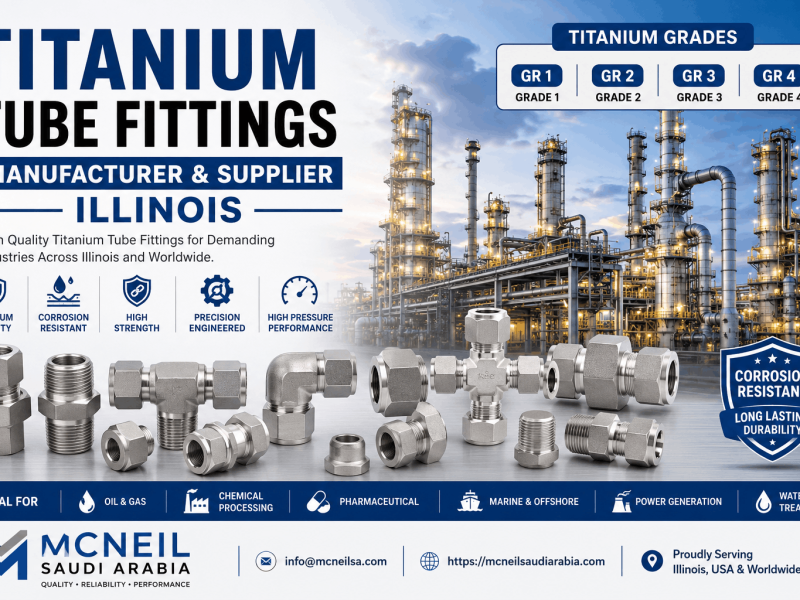
Titanium tube fittings are precision compression and threaded connectors machined from commercially pure titanium (Grades 1–4). They resist seawater, chlorides and oxidizing chemicals, and weigh about 40% less than steel. Mcneil manufactures Grade 1, 2, 3 and 4 titanium tube fittings in India and exports them to Illinois with EN 10204 3.1 material certificates, PMI and pressure testing. Grade 2 suits most general service, Grade 1 suits maximum formability, and Grades 3 and 4 suit higher-strength needs.
Titanium is the right answer to a specific problem: corrosive, chloride-bearing or oxidizing process streams where stainless steel pits, crevice-corrodes or cracks. It is not a universal upgrade, and a good specification starts with knowing where titanium works and where it does not.
This page covers the four CP titanium grades, the fitting types we supply, technical data, where titanium belongs in Illinois industry, how export to Illinois works, and what to send for a fast quotation. We are based in Mumbai, India. You buy direct from the manufacturer, and we handle documentation and shipping to your plant, distributor or fabricator.
What Are Titanium Tube Fittings?
Titanium tube fittings connect, redirect, reduce, branch or close off tubing in instrumentation, sampling, hydraulic, pneumatic and process lines. Most are compression fittings: a nut, one or two ferrules and a body grip the tube and create a metal-to-metal seal without welding.
Titanium protects itself with a thin, stable oxide film that re-forms instantly if scratched in the presence of oxygen or moisture. That film is why titanium handles seawater, chlorides, wet chlorine and many oxidizing acids that attack stainless steel.
Key Advantages of Titanium Tube Fittings
- Corrosion resistance: excellent in seawater, brines, chloride solutions, hypochlorite and nitric acid
- Low weight: density of 4.51 g/cm³, roughly 40% lighter than steel
- High strength-to-weight ratio: useful on skids, panels and offshore packages where weight matters
- Fatigue resistance: good performance under vibration and pressure cycling
- Long service life: a lower total cost of ownership where corrosion would otherwise force replacement
- Cryogenic toughness: titanium stays ductile at very low temperatures
Where Titanium Is Not the Right Choice
A fitting only performs if the material matches the service. Check these limits before you specify:
- Temperature: CP titanium is generally limited to about 300–315°C (roughly 600°F) for pressure-containing service. Above that, strength drops and oxygen pickup becomes a problem. For sustained high heat, consider alloys such as Incoloy 800H tube fittings.
- Reducing acids: hot or concentrated hydrochloric and sulfuric acid, and hydrofluoric acid at any meaningful concentration, attack titanium.
- Dry chlorine gas and red fuming nitric acid: both can cause rapid, severe reactions.
- Oxygen service: titanium is generally not used for pressurized oxygen systems.
- Hot concentrated chloride brines: crevice corrosion can occur, and Grade 7 or Grade 12 may be a better choice.
If you are unsure, send us your medium, concentration, temperature and pressure, and we will tell you plainly whether titanium or another alloy fits.
Titanium Grades We Supply for Illinois Projects
Grades 1 to 4 differ mainly in oxygen and iron content. More oxygen and iron means more strength and less ductility, while corrosion resistance stays very high across all four.
Titanium Grade 1 Tube Fittings (UNS R50250)
Grade 1 is the softest and most ductile CP grade, with the best formability and excellent resistance in many corrosive conditions.
Key Properties
- Highest ductility and formability among CP grades
- Excellent resistance to seawater and oxidizing media
- Lowest strength of the four grades
Typical Applications
- Chemical processing equipment
- Heat exchangers and condensers
- Desalination and water treatment
- Electroplating and surface-finishing lines
Titanium Grade 2 Tube Fittings (UNS R50400)
Grade 2 is the workhorse. It balances strength, corrosion resistance, formability and weldability, and it is the most commonly specified CP titanium.
Key Properties
- Good strength-to-ductility balance
- Excellent corrosion resistance in oxidizing and neutral chloride environments
- Wide availability of bar and tubing
Typical Applications
- Chemical and petrochemical instrumentation
- Offshore and marine instrumentation
- Pharmaceutical and biotech process lines
- Water treatment, including hypochlorite and chlorine dioxide systems
- Pulp bleaching and plating
For most buyers who ask for “titanium tube fittings,” Grade 2 is the right starting point.
Titanium Grade 3 Tube Fittings (UNS R50550)
Grade 3 offers noticeably higher strength than Grade 2 with similar corrosion behavior. It is used when higher pressure or load capacity is needed and a lower-strength grade would require heavier sections.
Key Properties
- Higher tensile and yield strength than Grades 1 and 2
- Very good corrosion resistance
- Lower ductility than Grade 2
Typical Applications
- Higher-pressure chemical process lines
- Pressure equipment where wall thickness is limited
- Industrial hydraulic and process systems
Titanium Grade 4 Tube Fittings (UNS R50700)
Grade 4 is the strongest CP titanium grade. It retains good corrosion resistance but has the lowest ductility, so it is harder to form and needs more care in machining and installation.
Key Properties
- Highest strength among CP grades
- Good corrosion resistance
- Lower elongation than the other three grades
Typical Applications
- High-strength instrumentation connections
- Pressure-critical process lines
- Applications where a stronger grade is specified by the design team
If your design calls for Ti-6Al-4V (Grade 5) or corrosion-enhanced grades such as Grade 7 or 12, ask us. Availability: [confirm which additional grades you can supply].
How to Choose Between Titanium Grades
| Factor | Grade 1 | Grade 2 | Grade 3 | Grade 4 |
|---|---|---|---|---|
| UNS | R50250 | R50400 | R50550 | R50700 |
| Strength | Lowest | Moderate | Higher | Highest CP |
| Ductility | Highest | High | Moderate | Lowest |
| Typical use | Formability-driven | General service | Higher-load service | Strength-driven |
| Availability | Good | Best | Moderate | Moderate |
A Simple Selection Guide
- Start with Grade 2 unless you have a reason not to. It is the most available and most proven grade.
- Choose Grade 1 if you need maximum formability or a softer material.
- Choose Grade 3 or 4 if pressure, wall thickness or load requires higher strength.
- Consider other alloys if temperature exceeds about 300–315°C or if reducing acids are present.
Common Selection Mistakes
- Choosing titanium for a hot reducing acid
- Ignoring crevice corrosion risk in hot chloride brines
- Using a high-strength grade without checking ductility and installation limits
- Mixing fitting and tubing grades without confirming hardness compatibility
Types of Titanium Tube Fittings We Supply
Our range follows the same configurations as our tube fittings range. Titanium versions are available on request.
Compression and Ferrule Fittings
Double ferrule fittings use separate front and back ferrules for strong grip and vibration resistance. Single ferrule designs offer a compact option for simpler service. Both let you assemble and disassemble without welding.
Titanium can gall, so ferrule design, surface treatment and assembly practice matter. [Describe your anti-galling approach, for example lubricant or surface treatment.]
Union Fittings
- Straight Union Tube Fittings join two tubes in line.
- Union Elbow Tube Fittings turn the line by 90 degrees.
- Union Tee Tube Fittings split or combine flow in three directions.
- Union Cross Tube Fittings serve four-way manifolds.
Reducing Fittings
Reducing Union Tube Fittings and Reducing Tee Tube Fittings connect tubes of different diameters without disrupting flow.
Bulkhead Fittings
Bulkhead Union Tube Fittings and Bulkhead Union Elbow Tube Fittings pass tubing through panels and enclosures while keeping the seal.
Male and Female Connectors
- Male Connector NPT Tube Fittings connect tubing to female threaded ports.
- Male Elbow NPT Tube Fittings add a 90-degree turn to a threaded end.
- Male Branch Tee Tube Fittings branch off a threaded run.
- Male Bulkhead Connector Tube Fittings provide a threaded end through a panel.
NPT is the usual US standard. We can also supply BSPT, BSPP and SAE threads.
Couplings, Plugs, Caps and Adapters
Couplings join straight tube sections. Plugs and caps close unused ports and tube ends. Adapters connect different thread types or sizes. For related pipe-end components, see our coupling, plug and union and end cap pipe fittings.
Technical Specifications of Titanium Tube Fittings
The table shows the general range. We confirm exact details on every quotation.
| Specification | Details |
|---|---|
| Grades | Titanium Grade 1, 2, 3, 4 |
| UNS numbers | R50250, R50400, R50550, R50700 |
| Fitting types | Union, elbow, tee, cross, reducer, connector, adapter, coupling, plug, cap, bulkhead union |
| Ferrule types | Single and double ferrule |
| Connection types | Compression, threaded |
| Thread standards | NPT, BSPT, BSPP, SAE |
| Size range | 1/16″ to 2″ OD, custom sizes on request [confirm] |
| Manufacturing | CNC machining from certified bar stock |
| Surface finish | Pickled, polished or machined |
| Testing | PMI, dimensional inspection, hydrostatic or pressure test |
| Certification | EN 10204 3.1 MTC, third-party inspection on request |
Applicable Standards
Material standards depend on the product form:
- ASTM B348: titanium and titanium alloy bars and billets, the usual source material for machined compression fittings
- ASTM B381: titanium forgings, applicable where fittings are forged
- ASTM B338: seamless and welded titanium tube for condensers and heat exchangers
- ASTM B363: wrought titanium butt-weld fittings
Tell us your governing specification and we will quote to match.
Pressure Ratings
Pressure ratings depend on tube OD, wall thickness, fitting design, grade and operating temperature, and they fall as temperature rises. Because one number can’t fairly cover every size, we provide the rated working pressure for your exact configuration. [Insert your test-backed rating chart.]
Tubing Compatibility
Use correctly sized, annealed tubing of compatible grade and hardness. For other alloys that pair with titanium systems in a project, see our tubes range, Inconel tubes and Hastelloy tubes.
Chemical Composition of Titanium Grades 1–4
Maximum values per ASTM, weight percent. Residual elements are 0.1% maximum each and 0.4% maximum total.
| Element | Grade 1 | Grade 2 | Grade 3 | Grade 4 |
|---|---|---|---|---|
| Titanium | Balance | Balance | Balance | Balance |
| Oxygen | 0.18 | 0.25 | 0.35 | 0.40 |
| Iron | 0.20 | 0.30 | 0.30 | 0.50 |
| Carbon | 0.08 | 0.08 | 0.08 | 0.08 |
| Nitrogen | 0.03 | 0.03 | 0.05 | 0.05 |
| Hydrogen | 0.015 | 0.015 | 0.015 | 0.015 |
Rising oxygen and iron from Grade 1 to Grade 4 is what raises strength.
Mechanical Properties of Titanium Grades 1–4
Values below are ASTM minimums for annealed material, not typical or guaranteed results for a finished fitting.
| Property | Grade 1 | Grade 2 | Grade 3 | Grade 4 |
|---|---|---|---|---|
| Tensile strength, min (MPa) | 240 | 345 | 450 | 550 |
| Yield strength, min (MPa) | 170 | 275 | 380 | 483 |
| Elongation, min (%) | 24 | 20 | 18 | 15 |
| Density (g/cm³) | 4.51 | 4.51 | 4.51 | 4.51 |
| Melting point (approx.) | 1,660°C | 1,660°C | 1,660°C | 1,660°C |
Features and Benefits of Titanium Tube Fittings
Outstanding Corrosion Resistance
The oxide film protects against seawater, chlorides and many oxidizing chemicals, which extends service life in places where stainless steel fails early.
Strong Resistance to Chloride Attack
Titanium is immune to chloride stress corrosion cracking in normal conditions, which is a known weakness of austenitic stainless steels. In hot, concentrated chloride brines, check for crevice corrosion risk.
Lightweight and Strong
At roughly 40% lighter than steel, titanium reduces load on supports, panels and offshore skids.
Fatigue Resistance
Good fatigue behavior helps in vibrating or pressure-cycling lines.
Low Maintenance
Where the chemistry suits titanium, it resists the pitting and scaling that force periodic replacement of other materials.
Cryogenic Performance
Titanium remains tough at very low temperatures, which suits cold-service instrumentation.
Biocompatibility
Titanium is non-toxic and widely used in pharmaceutical and biotech processing, though final suitability depends on your cleaning chemistry and validation requirements.
Lower Lifecycle Cost
Titanium costs more up front. In the right environment, fewer replacements and less downtime can reduce total cost over the life of the system.
Where Illinois Industries Use Titanium Tube Fittings
Illinois is inland, so seawater is not the main driver. The demand comes from chemical, chloride and oxidizing process streams, plus equipment builders who ship worldwide.
Chemical and Specialty Processing
Chemical plants across the Chicago and Joliet regions handle chloride, hypochlorite, chlorine dioxide and nitric acid streams. Grade 2 is the common choice for instrumentation lines in these services.
Water and Wastewater Treatment
Disinfection systems using hypochlorite or chlorine dioxide can attack stainless steel instrument tubing. Titanium resists these chemistries well.
Pharmaceutical, Biotech and Food Processing
Illinois has a large pharmaceutical, biotech and food-processing sector. Titanium is used where aggressive cleaning agents and purity requirements make material choice critical.
Power Generation
Power plants use titanium mainly where chloride-bearing cooling or process water is present. Check your plant’s chemistry before choosing it over stainless steel or nickel alloys.
Metal Finishing and Plating
Plating and surface-treatment lines use oxidizing and chloride-bearing baths where titanium holds up well.
Equipment Manufacturers and Skid Builders
Illinois fabricators supply marine, offshore and process-industry customers worldwide. Titanium fittings help them meet corrosion and weight requirements on exported equipment.
Research and Laboratory Facilities
Research labs and analytical facilities use titanium for clean, corrosion-resistant instrumentation lines in demanding experiments.
How We Supply Titanium Tube Fittings to Illinois from India
We manufacture in India and export directly to Illinois buyers.
Ordering Process
- Send your requirement: grade, fitting type, size, thread, quantity, standard and drawings.
- Receive a quotation with price, lead time and shipping terms.
- Approve drawings or samples for custom parts.
- Production and inspection with PMI, dimensional and pressure checks.
- Documentation and dispatch with certificates and export packing.
Lead Time, MOQ and Shipping
Standard items typically take [X–X weeks] and custom parts [X–X weeks]. Minimum order quantity is [MOQ]. We quote on [FOB, CIF or DAP terms]. Sea and air freight are available, and shipments usually enter through a US port before moving inland to Illinois.
Documentation Provided
- Mill Test Certificate, EN 10204 3.1
- PMI and test reports
- Commercial invoice, packing list and certificate of origin
- Third-party inspection certificates on request
- Heat-number traceability
Duties and Import Notes
Tariffs and duties on goods of Indian origin change. We state the origin on every document and help identify the applicable HS code so your customs broker can calculate landed cost. If your project has domestic-sourcing rules, tell us before ordering.
Packaging
Fittings are individually wrapped, end-capped to prevent contamination, packed in cartons or export-grade wooden boxes, and marked with heat numbers.
Quality Assurance and Testing
Every batch is traceable from raw material to dispatch.
- Positive Material Identification of bar stock and finished parts
- Chemical composition verification to ASTM limits
- Dimensional and thread gauge inspection
- Visual and surface inspection
- Hardness testing
- Hydrostatic or pressure testing
- Mechanical property testing where specified
- Third-party inspection on request
Review our quality policy, certificates and factory tour.
Complete Your Instrumentation System
- Valve fittings: needle valves, ball valves and manifold valves
- Instrumentation accessories: thermowells and snubbers
- Nickel-alloy alternatives: Incoloy tube fittings
Why Illinois Buyers Choose Mcneil
Factory-Direct Supply
You deal with the manufacturer, which gives you direct access to quality records and engineering support.
Honest Material Guidance
We tell you when titanium is not the right alloy for your service, and recommend alternatives.
Certified, Traceable Material
Every order ships with material certificates and heat-number traceability.
Custom Manufacturing
We machine non-standard sizes, threads and configurations from your drawings.
Clear Terms
We state our location, lead times and shipping terms up front.
Frequently Asked Questions About Titanium Tube Fittings in Illinois
Do you supply titanium tube fittings to Illinois?
Yes. We manufacture in India and export to customers and distributors in Illinois.
Are your fittings made in the USA?
No. They are made in India. If your project requires US-made material, tell us before ordering.
Which titanium grade is most common?
Grade 2, because it balances strength, corrosion resistance and availability.
What is the difference between Grade 1 and Grade 2?
Grade 1 is softer and more formable. Grade 2 is stronger and more widely used.
Is titanium resistant to seawater and chlorides?
Yes, in normal conditions. In hot, concentrated chloride brines, crevice corrosion can occur, so ask us about Grade 7 or 12.
What is the maximum temperature for titanium tube fittings?
CP titanium is generally limited to about 300–315°C (600°F) in pressure service. Check your design code for exact limits.
Which chemicals should I avoid with titanium?
Hydrofluoric acid, hot or concentrated hydrochloric and sulfuric acid, dry chlorine gas and red fuming nitric acid. Titanium is also generally not used for pressurized oxygen.
Can titanium fittings gall?
Titanium has a tendency to gall. Correct ferrule design, surface treatment and assembly practice reduce the risk. [Add your practice.]
What sizes are available?
Standard sizes run from 1/16″ to 2″ OD, with custom sizes on request [confirm].
What certificates do you provide?
EN 10204 3.1 MTC, PMI and test reports, with third-party inspection on request.
Can you make custom titanium fittings?
Yes. Send drawings or specifications for a quotation.
How long does delivery to Illinois take?
[Insert production and transit times.] We confirm timing in every quotation.
Request a Quote for Titanium Tube Fittings
For a fast, accurate quotation, send us:
- Titanium grade (1, 2, 3 or 4) or your service conditions
- Fitting type and thread standard
- Tube OD and wall thickness
- Quantity and delivery location in Illinois
- Medium, concentration, temperature and pressure
- Governing standard, drawings and certification needs
Request a quote and our team will reply with a grade recommendation, pricing, lead time and shipping terms. You can also learn more about our company.
Recent Comments