
Introduction
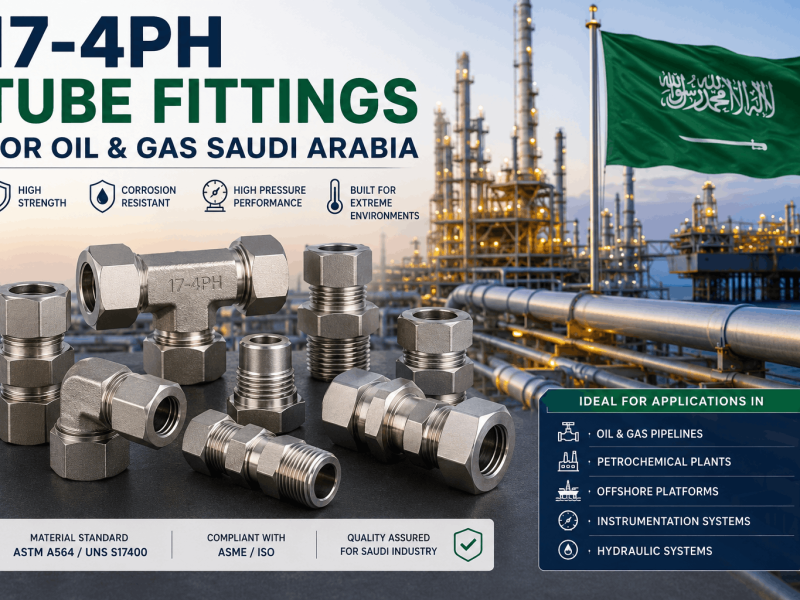
The demand for high-performance stainless steel components in the oil and gas industry continues to grow rapidly in Saudi Arabia, where extreme environmental conditions and large-scale industrial operations require materials with exceptional strength and corrosion resistance. Among these materials, 17-4PH stainless steel tube fittings have become a preferred choice for critical applications in pipelines, instrumentation systems, and hydraulic installations.
Saudi Arabia’s oil and gas sector—driven by major industrial players such as Saudi Aramco and petrochemical leaders like SABIC—operates in some of the most demanding environments in the world. High temperatures, saline coastal air, and chemically aggressive processing conditions require materials that maintain integrity under stress.
This article explores 17-4PH tube fittings in detail, including their properties, applications, advantages, and why they are widely used across the oil and gas infrastructure in Saudi Arabia.
What is 17-4PH Stainless Steel?
17-4PH (also known as UNS S17400) is a precipitation-hardening stainless steel that combines high strength with excellent corrosion resistance. The “PH” stands for precipitation hardening, a heat treatment process that significantly improves mechanical properties.
This alloy is widely used in industries where both strength and corrosion resistance are required, especially in oil and gas, aerospace, and marine environments.
Chemical Composition
17-4PH typically contains:
- Chromium (15–17.5%) for corrosion resistance
- Nickel (3–5%) for toughness and stability
- Copper (3–5%) for precipitation hardening
- Niobium/Columbium for strengthening
Each element contributes to making the alloy durable, strong, and suitable for harsh industrial environments.
Heat Treatment Process
The performance of 17-4PH depends heavily on heat treatment:
- Solution Treatment: The material is heated and rapidly cooled to dissolve alloying elements.
- Aging Process (H900, H1025 conditions): Strength is increased significantly through controlled heating.
This process allows engineers to customize strength and hardness depending on application requirements.
Key Properties of 17-4PH Tube Fittings
17-4PH tube fittings offer a combination of mechanical and chemical properties that make them ideal for oil and gas systems.
High Mechanical Strength
- Extremely high tensile strength
- Excellent yield strength compared to conventional stainless steels
- Suitable for high-pressure systems
Corrosion Resistance
- Performs well in chloride-rich environments
- Suitable for coastal and offshore installations in Saudi Arabia
- Better resistance than standard 304 stainless steel in many conditions
Thermal Stability
- Maintains structural integrity under high temperatures
- Suitable for refinery and processing environments
Pressure Resistance
- Designed for high-pressure hydraulic and instrumentation systems
- Ideal for safety-critical pipeline applications
Why Oil & Gas Industry in Saudi Arabia Uses 17-4PH Tube Fittings
Saudi Arabia is one of the world’s largest oil producers, and its infrastructure demands materials that can withstand continuous operational stress.
Harsh Environmental Conditions
The country faces:
- Extremely high desert temperatures
- Sand and dust exposure
- Coastal humidity in Gulf regions
These conditions accelerate corrosion and material fatigue in standard metals.
Large-Scale Industrial Operations
Facilities operated by Saudi Aramco and SABIC require fittings that ensure:
- Safety in high-pressure systems
- Minimal downtime
- Long operational lifespan
Safety and Reliability Requirements
Oil and gas systems are safety-critical. A failure in tube fittings can lead to leaks, shutdowns, or hazards. 17-4PH ensures:
- Structural reliability
- Resistance to mechanical stress
- Reduced maintenance frequency
Applications of 17-4PH Tube Fittings in Saudi Arabia
Oil and Gas Sector
- Pipeline instrumentation systems
- Hydraulic control systems
- Offshore drilling equipment
- Wellhead control lines
Petrochemical Plants
- Chemical processing lines
- High-pressure transfer systems
- Reactor feed systems
Power and Desalination Plants
- High-salinity seawater systems
- Steam and heat exchange systems
Offshore Platforms
- Marine corrosion resistance applications
- High-pressure fluid control systems
Advantages of 17-4PH Tube Fittings
1. Long Service Life
These fittings reduce the need for frequent replacements, making them cost-effective in long-term operations.
2. High Strength-to-Weight Ratio
They provide superior mechanical strength without excessive weight, which is essential in complex piping systems.
3. Reduced Maintenance Costs
Due to corrosion resistance and durability, maintenance cycles are significantly reduced.
4. Performance in Extreme Conditions
Whether exposed to heat, pressure, or corrosive environments, 17-4PH maintains consistent performance.
17-4PH vs Other Stainless Steels
Understanding material comparison helps in selecting the right fittings.
17-4PH vs 316 Stainless Steel
- 17-4PH offers higher strength
- 316 offers slightly better general corrosion resistance
- 17-4PH is preferred for high-pressure systems
17-4PH vs Duplex Stainless Steel
- Duplex is more corrosion-resistant in some environments
- 17-4PH provides better mechanical strength in compact systems
- Duplex is often more expensive
When to Choose 17-4PH
- High mechanical stress applications
- Moderate to high corrosion environments
- Oil and gas instrumentation systems
Standards and Certifications in Saudi Arabia
To be used in Saudi industrial projects, tube fittings must comply with strict international and regional standards.
International Standards
- ASTM A564 (material specification)
- UNS S17400 classification
- ASME compliance for pressure systems
Saudi Arabia Industrial Requirements
Major industrial operators such as Saudi Aramco and SABIC require:
- Material Test Certificates (MTC)
- Traceability documentation
- Third-party inspection approval
Importance of Certification
Certification ensures:
- Safety compliance
- Quality assurance
- Approval for large EPC projects
How to Choose the Right Supplier in Saudi Arabia
Selecting the right supplier is critical for ensuring long-term reliability.
Supplier Evaluation Factors
- Material authenticity and traceability
- Availability of certifications (ASTM, ASME)
- Proven industry experience
Delivery and Availability
Reliable suppliers should support major industrial hubs:
- Riyadh
- Dammam
- Jubail
- Yanbu
Technical Support
- Engineering consultation
- Custom fitting design support
- After-sales service
Major Industrial Zones Using Tube Fittings in Saudi Arabia
Jubail Industrial City
One of the largest petrochemical hubs in the world, heavily reliant on corrosion-resistant fittings.
Yanbu Industrial City
A major refining and export center requiring durable pipeline systems.
Dammam & Eastern Province
Close to major oil fields and offshore installations.
Riyadh Industrial Area
Supports manufacturing and infrastructure development projects.
Frequently Asked Questions (FAQ)
1. What is 17-4PH stainless steel used for?
17-4PH stainless steel is used in high-strength industrial applications such as oil and gas pipelines, instrumentation systems, aerospace components, and marine environments where both strength and corrosion resistance are required.
2. Is 17-4PH suitable for oil and gas applications in Saudi Arabia?
Yes. 17-4PH is widely used in Saudi Arabia’s oil and gas sector due to its high mechanical strength, corrosion resistance, and ability to perform in extreme heat, pressure, and coastal conditions.
3. What is the difference between 17-4PH and 316 stainless steel?
17-4PH offers significantly higher strength and hardness compared to 316 stainless steel, while 316 provides slightly better general corrosion resistance. 17-4PH is preferred for high-pressure and structural applications.
4. Why is 17-4PH preferred in Saudi Arabia’s oil and gas industry?
Because Saudi Arabia has harsh operating environments—high temperatures, desert conditions, and coastal corrosion—17-4PH provides long-lasting durability and reliability in critical systems.
5. What standards apply to 17-4PH tube fittings?
Common standards include ASTM A564 and UNS S17400. In Saudi Arabia, compliance with ASME codes and approval from industrial operators like Saudi Aramco and SABIC is often required.
6. Where are 17-4PH tube fittings commonly used in Saudi Arabia?
They are used in oil refineries, petrochemical plants, offshore drilling platforms, desalination plants, and high-pressure instrumentation systems.
7. How do I choose a supplier for tube fittings in Saudi Arabia?
Choose suppliers who provide certified materials, traceability documents, ASTM/ASME compliance, and proven experience supplying to oil and gas projects in Saudi Arabia.
Conclusion
17-4PH tube fittings play a critical role in Saudi Arabia’s oil and gas infrastructure, offering unmatched strength, corrosion resistance, and durability. In demanding environments such as refineries, offshore platforms, and petrochemical plants, these fittings ensure safety, efficiency, and long service life.
With increasing industrial expansion driven by major players like Saudi Aramco and SABIC, the demand for high-performance materials like 17-4PH stainless steel is expected to grow steadily.
For industries operating in harsh conditions, investing in high-quality 17-4PH tube fittings is not just a technical choice—it is a long-term reliability strategy.
Recent Comments