
Introduction
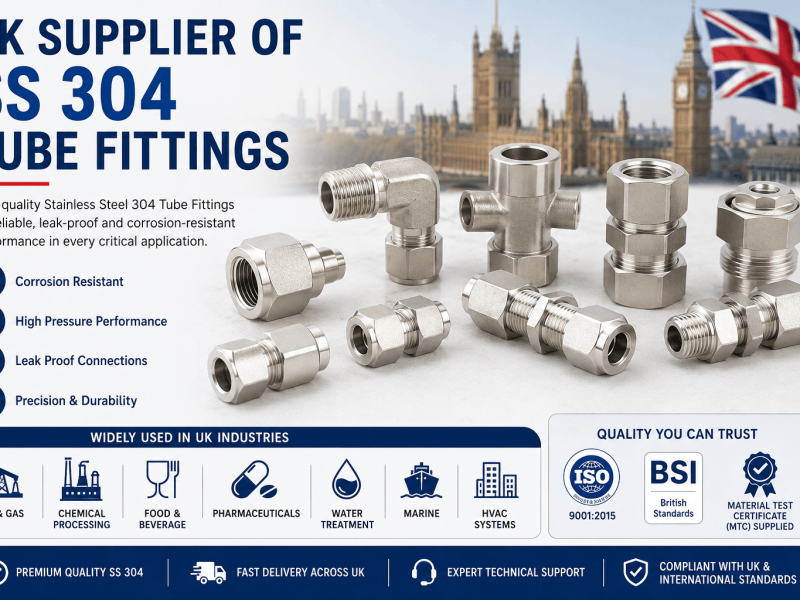
Industrial piping systems in the United Kingdom use stainless steel 304 tube fittings widely due to their strength, corrosion resistance, and long service life. In sectors such as oil and gas, food processing, pharmaceuticals, and marine engineering, demand for reliable stainless steel components continues to grow. Choosing a UK Supplier of SS 304 Tube Fittings ensures faster delivery, compliance with British standards, and consistent product quality for critical applications.
This article provides a complete guide to SS 304 tube fittings, including their features, applications, benefits, and how to choose the right supplier in the UK market.
What Are SS 304 Tube Fittings?
Manufacturers make SS 304 tube fittings from austenitic stainless steel grade 304, which typically contains 18% chromium and 8% nickel. This composition provides excellent corrosion resistance, good mechanical strength, and durability in a wide range of environments.
Tube fittings are used to connect, control, and direct the flow of liquids or gases within piping systems. Unlike welded connections, tube fittings allow for easier installation, maintenance, and system modifications.
UK industries use SS 304 fittings in both high-pressure and low-pressure systems where hygiene, safety, and reliability are essential. These fittings include compression fittings, connectors, elbows, tees, reducers, and adapters designed for precise fluid control.
Why SS 304 Tube Fittings Are Popular in the UK
The UK industrial sector demands materials that can perform reliably under varying environmental conditions, including humidity, temperature changes, and exposure to chemicals.
SS 304 tube fittings are widely preferred because:
- They offer strong corrosion resistance in most atmospheric and industrial environments
- They are cost-effective compared to higher-grade stainless steels like SS 316
- They perform well in UK coastal and marine environments
- They comply with widely accepted international and British standards
- They offer long operational life with minimal maintenance
For industries operating in the UK, these advantages make SS 304 fittings a balanced solution between performance and affordability.
Key Features of SS 304 Tube Fittings
SS 304 tube fittings are engineered to meet demanding industrial requirements. Their key features include:
Corrosion Resistance
The chromium content forms a protective oxide layer, preventing rust and corrosion in most environments.
High Strength and Durability
SS 304 fittings can withstand mechanical stress and pressure variations, making them suitable for industrial pipelines.
Temperature Resistance
These fittings perform effectively in both high and low-temperature conditions, common in UK industrial applications.
Leak-Proof Design
Precision engineering ensures tight sealing, reducing the risk of leakage in fluid and gas systems.
Hygienic Properties
SS 304 is widely used in food and pharmaceutical industries due to its smooth surface and ease of cleaning.
Low Maintenance
Once installed, these fittings require minimal maintenance, reducing long-term operational costs.
Types of SS 304 Tube Fittings Available in the UK
A wide range of SS 304 tube fittings are used across UK industries depending on system requirements.
Compression Fittings
Used for creating tight, leak-proof connections without welding.
Double Ferrule Fittings
Provide enhanced grip and sealing, commonly used in instrumentation systems.
Elbow Fittings
Available in 45° and 90° angles, used to change flow direction in piping systems.
Tee Fittings
Allow branching of pipelines into two directions.
Reducers
Used to connect tubes of different diameters.
Union Fittings
Enable easy disconnection and reconnection of pipe sections.
Bulkhead Fittings
Used for passing tubes through panels or walls securely.
Each type plays a crucial role in ensuring efficient and safe fluid transfer across industrial systems.
Applications of SS 304 Tube Fittings in UK Industries
SS 304 tube fittings are used across a wide range of UK industries due to their versatility and reliability.
Oil and Gas Industry
Used in offshore rigs, refineries, and pipeline systems where durability is critical.
Chemical Processing
Resistant to mild chemicals, making them suitable for processing plants.
Food and Beverage Industry
Used in hygienic piping systems for dairy, brewing, and food production facilities.
Pharmaceutical Industry
Ensures sterile and contamination-free fluid transfer systems.
Water Treatment Plants
Used in filtration and distribution systems for clean and wastewater management.
Marine Industry
Ideal for shipbuilding and offshore applications due to corrosion resistance.
HVAC Systems
Used in heating, ventilation, and air conditioning systems in commercial buildings.
Standards and Certifications in the UK Market
In the UK industrial sector, compliance with international and British standards is essential for safety and quality assurance.
SS 304 tube fittings typically comply with:
- ASTM A182 and ASTM A276 standards
- British Standards (BS) specifications
- ISO 9001 quality management systems
- Pressure testing and performance certification requirements
Material Test Certificates (MTCs) are often provided to ensure traceability and compliance with procurement requirements in UK projects.
These certifications help ensure that fittings meet strict safety and performance standards required in industrial applications.
Benefits of Choosing a UK Supplier of SS 304 Tube Fittings
Working with a reliable UK Supplier of SS 304 Tube Fittings provides several strategic advantages for industrial buyers.
Faster Delivery Times
Local suppliers ensure quicker dispatch and reduced lead times compared to overseas sourcing.
Compliance with UK Standards
Products meet British and European industrial regulations, ensuring safe usage in regulated industries.
Reduced Import Costs
Eliminates shipping delays, customs duties, and import-related expenses.
Technical Support
Local suppliers provide easier access to engineering and technical assistance.
Quality Assurance
Products can be inspected and verified more easily within the UK.
Better Inventory Availability
UK suppliers often maintain ready stock for urgent industrial requirements.
These advantages make local sourcing a preferred option for many engineering and procurement teams.
SS 304 vs SS 316 Tube Fittings
Understanding the difference between SS 304 and SS 316 helps in selecting the right material.
SS 304 Tube Fittings
- Cost-effective
- Good corrosion resistance
- Suitable for general industrial use
- Widely used in UK applications
SS 316 Tube Fittings
- Contains molybdenum for higher corrosion resistance
- Better for marine and chemical-heavy environments
- More expensive than SS 304
For most UK industrial applications, SS 304 provides an ideal balance of cost and performance.
How to Choose the Right Supplier in the UK
Selecting the right supplier is critical for ensuring product reliability and long-term performance.
Key factors include:
- Certification and compliance with international standards
- Availability of technical documentation and MTCs
- Manufacturing capability and quality control processes
- Product range and stock availability
- Delivery timelines across the UK
- Industry experience and reputation
- After-sales support and service responsiveness
A trusted supplier ensures consistent quality and reduces operational risks in industrial systems.
Why SS 304 Tube Fittings Are Cost-Effective
SS 304 tube fittings offer an excellent balance between cost and performance, making them ideal for large-scale industrial projects in the UK.
Their cost-effectiveness comes from:
- Lower material cost compared to higher-grade alloys
- Long service life reduces replacement frequency
- Minimal maintenance requirements
- Reduced downtime in industrial operations
This makes them a preferred choice for engineers and procurement managers aiming to optimize project budgets without compromising quality.
FAQs – SS 304 Tube Fittings (UK)
What are SS 304 tube fittings used for?
SS 304 tube fittings connect, control, and direct the flow of liquids or gases in industrial piping systems. Industries such as oil & gas, food processing, pharmaceuticals, water treatment, and marine in the UK widely use these fittings.
Are SS 304 tube fittings suitable for UK weather conditions?
Yes, SS 304 tube fittings perform well in typical UK environmental conditions, including humidity and coastal air exposure. Their corrosion resistance makes them suitable for both indoor and outdoor industrial applications.
What is the difference between SS 304 and SS 316 tube fittings?
SS 304 offers good corrosion resistance and is suitable for general industrial use, while SS 316 contains molybdenum, providing higher resistance to harsh chemicals and marine environments. SS 316 is more expensive than SS 304.
Do UK suppliers provide certification for SS 304 tube fittings?
Yes, reputable UK suppliers typically provide Material Test Certificates (MTC), ISO certifications, and compliance documents to ensure traceability and quality assurance for industrial applications.
Can SS 304 tube fittings handle high pressure?
Yes, SS 304 tube fittings are designed for moderate to high-pressure systems depending on their design and specifications. They are commonly used in instrumentation and hydraulic applications across UK industries.
Where are SS 304 tube fittings commonly used in the UK?
They are widely used in oil and gas pipelines, chemical processing plants, food and beverage manufacturing, pharmaceutical production, water treatment facilities, and HVAC systems.
Why should I choose a UK supplier for SS 304 tube fittings?
Choosing a UK supplier ensures faster delivery, compliance with British standards, easier quality verification, and better technical support compared to overseas sourcing.
Conclusion
SS 304 tube fittings play a vital role in modern industrial systems across the United Kingdom. Their durability, corrosion resistance, and versatility make them suitable for a wide range of applications, from food processing to heavy engineering.
Choosing a reliable UK Supplier of SS 304 Tube Fittings ensures access to high-quality components that comply with industry standards and deliver consistent performance in demanding environments.
With the right supplier, industries can achieve improved efficiency, reduced maintenance costs, and long-term operational reliability in their piping systems.
Recent Comments